


Well, we’ve officially hit the third straight week of market declines, and it’s starting to feel a bit tougher to brush off. Last week was especially rough, with the TSX and S&P both dropping 3%, while the NASDAQ tumbled 4%. Even the once-unstoppable Magnificent 7 stocks sank more than 5%. With the ongoing trade tensions and shifting U.S. policies, investors are on edge, and it’s clear that concerns about economic growth and inflation are weighing heavily on the market.
To make matters worse, we saw the U.S. government moving forward with tariffs on Mexican and Canadian goods, and that sparked significant volatility across the markets. The Standard & Poor's 500 Index fell 3.10%, while the Nasdaq Composite dropped 3.45%. The Dow Jones Industrial Average wasn’t spared either, sliding 2.37%. Meanwhile, the MSCI EAFE Index, tracking developed overseas markets, actually managed to rally by 2.85%, offering a bit of relief to international investors.
What Happened Last Week? - Tariffs Take Effect
It wasn’t just trade concerns that caused the markets to stutter—economic data like soft manufacturing and construction reports added pressure. By midweek, things were looking grim as tariffs triggered retaliatory actions from Canada, Mexico, and China, which only fueled inflation worries among investors. By Tuesday’s close, all three major U.S. averages were down about 3% on the week, with the S&P 500 losing its post-election gains. That’s when the downward pressure really kicked in.
The markets got a brief reprieve when the White House announced a temporary suspension of tariffs on North American automakers. This sparked a bit of a rebound as investors began to hope that more exemptions could follow. But any optimism was short-lived. The renewed focus on tariffs, combined with a mixed bag of economic data and comments from the Treasury Secretary defending the U.S. tariff strategy, dampened the recovery. The Nasdaq even slid into correction territory, while the S&P 500 hit its sixth consecutive day of volatility—something we haven’t seen in five years.
Then came a disappointing February jobs report, adding more fuel to the fire. Yet, despite all the headwinds, the markets found a bit of footing when Federal Reserve Chair Jerome Powell reassured the public that the economy remains strong, and the Fed wasn’t planning on changing rates anytime soon. By Friday’s close, the S&P, Dow, and Nasdaq all bounced back, finishing the day in the green, even though the week ended in the red. It’s a reminder that even in a volatile market, there are always reasons to be cautious but also reasons to consider the opportunities.
Through all the ups and downs, the markets have consistently shown resilience. It’s in times of uncertainty that new opportunities are often born—whether it's through innovation, shifts in policy, or strategic moves by investors. So while the path ahead may have some bumps, there’s always the potential for growth and new possibilities on the horizon. The key is to stay focused, stay informed, and be ready for what comes next.
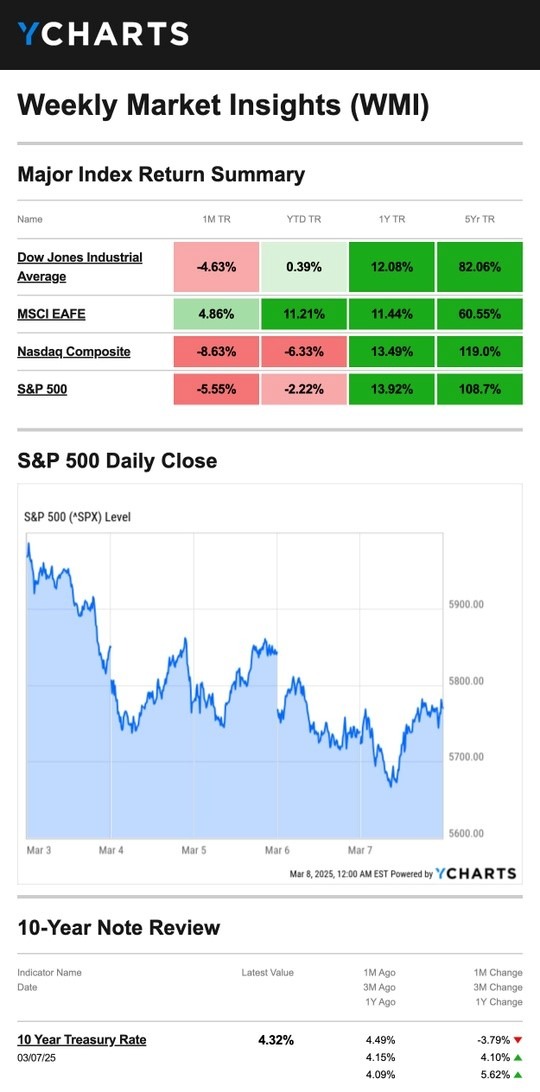
Source: YCharts.com, March 8, 2025. Weekly performance is measured from Monday, March 3, to Friday, March 7. TR = total return for the index, which includes any dividends as well as any other cash distributions during the period. Treasury note yield is expressed in basis points.
Under the Hood
The Institute for Supply Management (ISM) published fresh manufacturing data on Monday. Although headline numbers were decent, a closer look revealed that new orders dropped in January from a years-long high into correction territory while deliveries and prices paid jumped.8
This Week: Key Economic Data
Tuesday: Job Openings. NFIB Small Business Optimism Index.
Wednesday: Consumer Price Index (CPI). Federal Budget. Treasury Announcement.
Thursday: Producer Price Index (PPI). Initial Jobless Claims.
Friday: Consumer Sentiment.
Source: Investors Business Daily - Econoday economic calendar; March 7, 2025
The Econoday economic calendar lists upcoming U.S. economic data releases (including key economic indicators), Federal Reserve policy meetings, and speaking engagements of Federal Reserve officials. The content is developed from sources believed to be providing accurate information. The forecasts or forward-looking statements are based on assumptions and may not materialize. The forecasts also are subject to revision.
This Week: Companies Reporting Earnings
Monday: Oracle Corporation (ORCL)
Wednesday: Adobe Inc. (ADBE)
Source: Zacks, March 7, 2025. Companies mentioned are for informational purposes only. It should not be considered a solicitation for the purchase or sale of the securities. Investing involves risks, and investment decisions should be based on your own goals, time horizon, and tolerance for risk. The return and principal value of investments will fluctuate as market conditions change. When sold, investments may be worth more or less than their original cost. Companies may reschedule when they report earnings without notice.

“Surround yourself with people only who are going to take you higher."
– Oprah Winfrey

"What binds two people together yet touches only one person at a time?"
Last week's riddle: "I have rosy cheeks, I am round and cute – yet debate persists over whether I am vegetable or fruit. What might I be?"
Answer: A Tomato


Joanne's dogs, Austin & Taz, feeling pretty sad having to be lampshades after their neuter.
Footnotes and Sources
1. The Wall Street Journal, March 7, 2025
2. Investing.com, March 7, 2025
3. The Wall Street Journal, March 3, 2025
4. CNBC.com, March 4, 2025
5. CNBC.com, March 5, 2025
6. CNBC.com, March 6, 2025
7. MarketWatch.com, March 7, 2025
8. The Wall Street Journal, March 4, 2025
9. IRS.gov, September 26, 2024
10. Healthline, October 3, 2024
Investing involves risks, and investment decisions should be based on your own goals, time horizon, and tolerance for risk. The return and principal value of investments will fluctuate as market conditions change. When sold, investments may be worth more or less than their original cost.
The forecasts or forward-looking statements are based on assumptions, may not materialize, and are subject to revision without notice.
The market indexes discussed are unmanaged, and generally, considered representative of their respective markets. Index performance is not indicative of the past performance of a particular investment. Indexes do not incur management fees, costs, and expenses. Individuals cannot directly invest in unmanaged indexes. Past performance does not guarantee future results.
The Dow Jones Industrial Average is an unmanaged index that is generally considered representative of large-capitalization companies on the U.S. stock market. Nasdaq Composite is an index of the common stocks and similar securities listed on the NASDAQ stock market and is considered a broad indicator of the performance of technology and growth companies. The MSCI EAFE Index was created by Morgan Stanley Capital International (MSCI) and serves as a benchmark of the performance of major international equity markets, as represented by 21 major MSCI indexes from Europe, Australia, and Southeast Asia. The S&P 500 Composite Index is an unmanaged group of securities that are considered to be representative of the stock market in general.
U.S. Treasury Notes are guaranteed by the federal government as to the timely payment of principal and interest. However, if you sell a Treasury Note prior to maturity, it may be worth more or less than the original price paid. Fixed income investments are subject to various risks including changes in interest rates, credit quality, inflation risk, market valuations, prepayments, corporate events, tax ramifications and other factors.
International investments carry additional risks, which include differences in financial reporting standards, currency exchange rates, political risks unique to a specific country, foreign taxes and regulations, and the potential for illiquid markets. These factors may result in greater share price volatility.
Please consult your financial professional for additional information.