


Last week felt a bit stagnant for stocks, with geopolitical tensions introducing some unpredictability into what was otherwise a quiet trading atmosphere.
The Dow Jones Industrial Average barely moved, inching up just 0.09 percent, while the S&P 500 managed a slight increase of 0.22 percent. The Nasdaq Composite mirrored the Dow's steadiness with a flat performance of 0.10 percent. However, the MSCI EAFE Index, which tracks developed international markets, faced a rougher ride, falling 3.74 percent amid the unfolding geopolitical events. It’s a reminder that even in quieter times, external factors can shake things up.
Stocks Flat, Oil Spikes
On Monday, stocks edged up slightly, buoyed by optimistic remarks from Fed Chair Jerome Powell. This modest momentum helped the S&P 500 and Dow reach new record highs.
As tensions in the Middle East intensified on the first day of October, the market reacted with declines in stocks, rising bond yields, and climbing oil prices.
By Wednesday, all three major averages were essentially flat. An ADP report revealed stronger-than-expected job growth in the private sector, a figure that always captures investors’ attention. Meanwhile, oil prices continued to rise as the situation in the Middle East developed.
However, Friday brought a turnaround as stocks surged following the Labor Department’s September jobs report, which exceeded expectations.
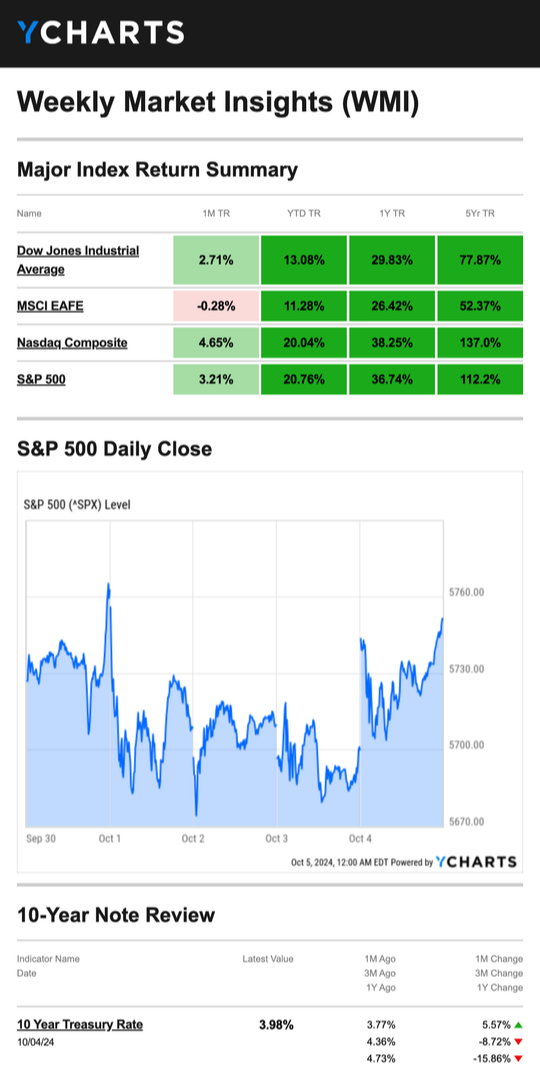
Source: YCharts.com, October 5, 2024. Weekly performance is measured from Monday, September 30, to Friday, October 4. TR = total return for the index, which includes any dividends as well as any other cash distributions during the period. Treasury note yield is expressed in basis points
Jobs Out Front
The Labor Department's jobs report provided investors with much-needed clarity on the job market. At its September meeting, the Fed highlighted its close attention to job trends, making these updates just as crucial as inflation reports.
The latest data revealed that employers added 254,000 jobs—around 100,000 more than economists had anticipated. Additionally, the unemployment rate dipped to 4.1 percent last month, which is encouraging news for the economy.
This Week: Key Economic Data
Monday: Fed Officials Neel Kashkari, Raphael Bostic, and Alberto Musalem speak. Consumer Credit.
Tuesday: International Trade in Goods & Services. Fed Officials Raphael Bostic and Susan Collins speak.
Wednesday: FOMC Minutes. EIA Petroleum Status Report. Fed Officials Raphael Bostic, Lori Logan, Austan Goolsbee, Thomas Barkin, Susan Collins and Mary Daly speak.
Thursday: Consumer Price Index. Weekly Jobless Claims. Fed Balance Sheet. Fed Official John Williams speaks.
Friday: Producer Price Index. Consumer Sentiment. Fed Officials Austan Goolsbee, Lori Logan, and Michelle Bowman speak.
This Week: Companies Reporting Earnings
Tuesday: PepsiCo, Inc. (PEP)
Thursday: Infosys / American Noble Gas Inc. (INFY), Delta Air Lines, Inc. (DAL)
Friday: JPMorgan Chase & Co. (JPM), Wells Fargo & Company (WFC), The Progressive Corporation (PGR), BlackRock, Inc. (BLK), The Bank of New York Mellon Corporation (BK)
Source: Zacks, October 4, 2024
Companies mentioned are for informational purposes only. It should not be considered a solicitation for the purchase or sale of the securities. Investing involves risks, and investment decisions should be based on your own goals, time horizon, and tolerance for risk. The return and principal value of investments will fluctuate as market conditions change. When sold, investments may be worth more or less than their original cost. Companies may reschedule when they report earnings without notice

“You can’t judge right from looking at what’s wrong.”
- Bo Diddley

I have rough skin and sometimes more than two eyes, but I can be tasty when prepared plainly and simply. What am I?
Last week’s riddle:I speak without a mouth and hear without ears. I have no body, but I come alive with the wind. What am I?
Answer: Echo


Joanne's son, Matthew, enjoying Willows Beach.
Footnotes and Sources
- The Wall Street Journal, October 4, 2024
- Investing.com, October 4, 2024
- CNBC.com, September 30, 2024
- The Wall Street Journal, October 1, 2024
- The Wall Street Journal, October 2, 2024
- The Financial Times, October 3, 2024
- The Wall Street Journal, October 4, 2024
- The Wall Street Journal, October 2, 2024
- The Wall Street Journal, October 4, 2024
- IRS.gov, July 24, 2024
- Daily Burn, July 24, 2024
Investing involves risks, and investment decisions should be based on your own goals, time horizon, and tolerance for risk. The return and principal value of investments will fluctuate as market conditions change. When sold, investments may be worth more or less than their original cost.
The forecasts or forward-looking statements are based on assumptions, may not materialize, and are subject to revision without notice.
The market indexes discussed are unmanaged, and generally, considered representative of their respective markets. Index performance is not indicative of the past performance of a particular investment. Indexes do not incur management fees, costs, and expenses. Individuals cannot directly invest in unmanaged indexes. Past performance does not guarantee future results.
The Dow Jones Industrial Average is an unmanaged index that is generally considered representative of large-capitalization companies on the U.S. stock market. Nasdaq Composite is an index of the common stocks and similar securities listed on the NASDAQ stock market and is considered a broad indicator of the performance of technology and growth companies. The MSCI EAFE Index was created by Morgan Stanley Capital International (MSCI) and serves as a benchmark of the performance of major international equity markets, as represented by 21 major MSCI indexes from Europe, Australia, and Southeast Asia. The S&P 500 Composite Index is an unmanaged group of securities that are considered to be representative of the stock market in general.
U.S. Treasury Notes are guaranteed by the federal government as to the timely payment of principal and interest. However, if you sell a Treasury Note prior to maturity, it may be worth more or less than the original price paid. Fixed income investments are subject to various risks including changes in interest rates, credit quality, inflation risk, market valuations, prepayments, corporate events, tax ramifications and other factors.
International investments carry additional risks, which include differences in financial reporting standards, currency exchange rates, political risks unique to a specific country, foreign taxes and regulations, and the potential for illiquid markets. These factors may result in greater share price volatility.
Please consult your financial professional for additional information.