


Last week brought some turbulence to the markets, and if you’ve been following your portfolio closely, you might have noticed the dips. Stocks were under pressure, partly due to the Federal Reserve Chair’s hawkish comments, which unsettled investors as the holiday season approaches.
In Canada, the S&P/TSX Composite Index followed global trends and ended the week down 1.9%. Energy stocks took a notable hit as oil prices slid, while technology stocks showed resilience compared to other sectors. The materials sector also saw declines, reflecting pressures in commodity markets.
Looking at U.S. benchmarks, the Dow Jones Industrial Average took the biggest hit, falling 2.25%. The S&P 500 lost 1.98%, and the Nasdaq Composite dropped 1.78%. On the international front, the MSCI EAFE Index, which tracks developed overseas stock markets, retreated by 3.38%.
No Santa Yet
This past week has been eventful for investors, with significant developments both in the markets and in Canadian politics.
Early in the week, we observed a divergence: megacap tech stocks rallied, while the Dow Jones Industrial Average fell for the eighth straight session—its longest losing streak since 2018.
Midweek, the Federal Reserve's December meeting concluded with a quarter-point cut in short-term rates, as anticipated. However, Fed Chair Jerome Powell signaled caution regarding future cuts, stating, "From here, it’s a new phase and we’re going to be cautious about further cuts." This unexpected stance prompted investors to reassess their expectations.
Adding to the week's volatility, Finance Minister Chrystia Freeland resigned from her position, citing disagreements with Prime Minister Justin Trudeau over economic policies and the handling of impending U.S. tariffs. Her departure has introduced uncertainty into Canada's economic landscape, potentially influencing market sentiment.
On Friday, markets faced additional pressure due to concerns over a stalled federal spending bill. However, a lower-than-expected inflation report provided a boost, helping to recover some earlier losses.
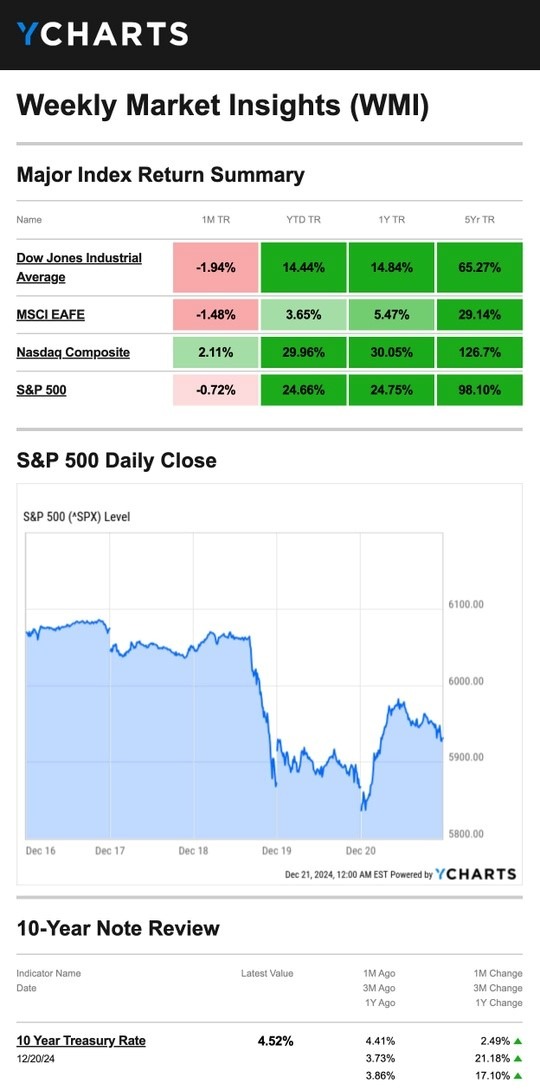
Source: YCharts.com, December 21, 2024. Weekly performance is measured from Monday, December 16, to Friday, December 20. TR = total return for the index, which includes any dividends as well as any other cash distributions during the period. Treasury note yield is expressed in basis points.
Holiday Cheer
Despite a difficult week, stocks are on track to have their second consecutive year of double-digit returns. Year to date, through Friday’s close, the S&P 500 was ahead by about 24 percent. In 2023, the S&P 500 also tacked on 24 percent for the full year.8
This Week: Key Economic Data
Monday: Consumer Confidence.
Tuesday: Durable Goods. New Home Sales.
Wednesday: Stock market closed.
Thursday: Weekly Jobless Claims. Fed Balance Sheet.
Friday: International Trade in Goods.
Source: Investors Business Daily - Econoday economic calendar; December 16, 2024
The Econoday economic calendar lists upcoming U.S. economic data releases (including key economic indicators), Federal Reserve policy meetings, and speaking engagements of Federal Reserve officials. The content is developed from sources believed to be providing accurate information. The forecasts or forward-looking statements are based on assumptions and may not materialize. The forecasts also are subject to revision.
This Week: Companies Reporting Earnings
No companies are scheduled to report results this week.
Source: Zacks, December 16, 2024. Companies mentioned are for informational purposes only. It should not be considered a solicitation for the purchase or sale of the securities. Investing involves risks, and investment decisions should be based on your own goals, time horizon, and tolerance for risk. The return and principal value of investments will fluctuate as market conditions change. When sold, investments may be worth more or less than their original cost. Companies may reschedule when they report earnings without notice.

“Life shrinks or expands according to one's courage.”
– Anaïs Nin

It softly goes up and down the stairs in many homes and office buildings, yet it never moves. What could it be?
Last week’s riddle: It is in seconds, seasons, centuries, and minutes, but you won’t find it in years, decades, or days. What is it?
Answer: The letter N.


Summer flashback to Matthew at Thetis Lake 2024.
Footnotes and Sources
- The Wall Street Journal, December 20, 2024
- Investing.com, December 20, 2024
- CNBC.com, December 16, 2024
- CNBC.com, December 17, 2024
- The Wall Street Journal, December 18, 2024
- CNBC.com, December 19, 2024
- CNBC.com, December 20, 2024
- The Wall Street Journal, December 20, 2024
- IRS.gov, January 10, 2024
- Healthline, August 1, 2024
Investing involves risks, and investment decisions should be based on your own goals, time horizon, and tolerance for risk. The return and principal value of investments will fluctuate as market conditions change. When sold, investments may be worth more or less than their original cost.
The forecasts or forward-looking statements are based on assumptions, may not materialize, and are subject to revision without notice.
The market indexes discussed are unmanaged, and generally, considered representative of their respective markets. Index performance is not indicative of the past performance of a particular investment. Indexes do not incur management fees, costs, and expenses. Individuals cannot directly invest in unmanaged indexes. Past performance does not guarantee future results.
The Dow Jones Industrial Average is an unmanaged index that is generally considered representative of large-capitalization companies on the U.S. stock market. Nasdaq Composite is an index of the common stocks and similar securities listed on the NASDAQ stock market and is considered a broad indicator of the performance of technology and growth companies. The MSCI EAFE Index was created by Morgan Stanley Capital International (MSCI) and serves as a benchmark of the performance of major international equity markets, as represented by 21 major MSCI indexes from Europe, Australia, and Southeast Asia. The S&P 500 Composite Index is an unmanaged group of securities that are considered to be representative of the stock market in general.
U.S. Treasury Notes are guaranteed by the federal government as to the timely payment of principal and interest. However, if you sell a Treasury Note prior to maturity, it may be worth more or less than the original price paid. Fixed income investments are subject to various risks including changes in interest rates, credit quality, inflation risk, market valuations, prepayments, corporate events, tax ramifications and other factors.
International investments carry additional risks, which include differences in financial reporting standards, currency exchange rates, political risks unique to a specific country, foreign taxes and regulations, and the potential for illiquid markets. These factors may result in greater share price volatility.
Please consult your financial professional for additional information.