


It was a week of ups and downs for global markets, as stocks edged lower despite a strong rally to close out the week.
In the U.S., the S&P 500 slipped 0.48%, the Nasdaq dropped 0.51%, and the Dow Jones Industrial Average declined 0.60%. Internationally, the MSCI EAFE Index, which tracks developed overseas stock markets, fell 0.90%.
Selling, Then Buying
The week started on shaky ground, with investors seemingly concerned about a lack of year-end momentum. Monday saw markets recover some losses by the close, but selling intensified on Tuesday. After a New Year’s Day pause, markets opened higher on Wednesday, only to falter by the close. However, a Friday rally, led by tech stocks, helped recover much of the week’s earlier losses.
A Look at Canadian Market
Closer to home, the Canadian market reflected a similar pattern. The S&P/TSX Composite Index finished the week slightly lower, dragged down by energy and financials, which struggled amid fluctuating oil prices and concerns about economic growth. Meanwhile, the tech and materials sectors showed resilience, contributing to a more optimistic tone by Friday.
While the new year may have started with market jitters, it’s a reminder that volatility is part of the investing journey. Staying focused on long-term goals rather than short-term movements is key.
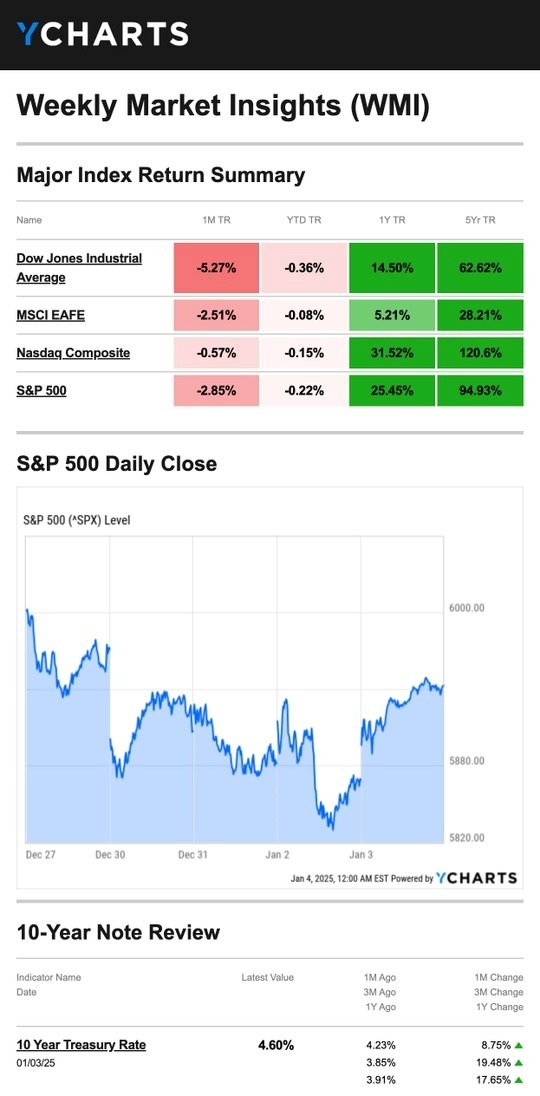
Source: YCharts.com, January 4, 2025. Weekly performance is measured from Friday, December 27, to Friday, January 3. TR = total return for the index, which includes any dividends as well as any other cash distributions during the period. Treasury note yield is expressed in basis points.
Megacap’s Mega Influence
If you’ve been keeping an eye on the markets over the past couple of years, you’ve likely noticed a recurring theme: megacap tech stocks stealing the show. And it’s not just headlines—these tech giants have been doing the heavy lifting for the market.
The S&P 500’s impressive double-digit returns—24% in 2023 and 23% in 2024—owe much of their strength to a select group of tech leaders. In fact, over the past 12 months, more than half (53%) of the index’s gains came from just seven companies often dubbed the “Magnificent Seven.” These household names have become the powerhouses of the market, driving performance and shaping portfolios in ways few could have imagined a decade ago.
It’s a testament to the outsized influence a handful of companies can have on the broader market. Whether you’re cheering them on or watching cautiously, their impact is undeniable.
This Week: Key Economic Data
Monday: Fed Official Lisa Cook speaks. Factory Orders.
Tuesday: Fed Official Thomas Barkin speaks. International Trade in Goods and Services.
Wednesday: FOMC Minutes released. ADP Employment Report. Fed Official Christopher Waller speaks.
Thursday: Stock market closed for President Carter’s state funeral.
Friday: Employment Situation. Consumer Sentiment.
Source: Investors Business Daily - Econoday economic calendar; January 3, 2025
The Econoday economic calendar lists upcoming U.S. economic data releases (including key economic indicators), Federal Reserve policy meetings, and speaking engagements of Federal Reserve officials. The content is developed from sources believed to be providing accurate information. The forecasts or forward-looking statements are based on assumptions and may not materialize. The forecasts also are subject to revision.
This Week: Companies Reporting Earnings
Wednesday: Jefferies Financial Group Inc. (JEF)
Thursday: Infosys (INFY), Constellation Brands Inc. (STZ)
Friday: Bank of America Corporation (BAC), Wells Fargo & Company (WFC), BlackRock, Inc. (BLK), Delta Air Lines, Inc. (DAL)
Source: Zacks, January 3, 2025. Companies mentioned are for informational purposes only. It should not be considered a solicitation for the purchase or sale of the securities. Investing involves risks, and investment decisions should be based on your own goals, time horizon, and tolerance for risk. The return and principal value of investments will fluctuate as market conditions change. When sold, investments may be worth more or less than their original cost. Companies may reschedule when they report earnings without notice.

“The biggest disease today is not leprosy or tuberculosis, but rather the feeling of being unwanted.”
– Mother Teresa

David put on a white shirt with three large holes in it and went to the grocery store. No one gave him a funny look; no one objected to it. What kind of shirt was David wearing?
Last week's riddle: It softly goes up and down the stairs in many homes and office buildings, yet it never moves. What could it be?
Answer: Carpet


Melissa's son, Marshall, has officially been accepted to go on a 1 year youth exchange program to Japan!
Footnotes and Sources
- The Wall Street Journal, January 3, 2025
- Investing.com, January 3, 2025
- CNBC.com, December 30, 2024
- The Wall Street Journal, December 31, 2024
- CNBC.com, January 2, 2025
- CNBC.com, January 3, 2025
- The Wall Street Journal, December 31, 2024
- IRS.gov, October 2, 2024
- Healthline, October 3, 2024
Investing involves risks, and investment decisions should be based on your own goals, time horizon, and tolerance for risk. The return and principal value of investments will fluctuate as market conditions change. When sold, investments may be worth more or less than their original cost.
The forecasts or forward-looking statements are based on assumptions, may not materialize, and are subject to revision without notice.
The market indexes discussed are unmanaged, and generally, considered representative of their respective markets. Index performance is not indicative of the past performance of a particular investment. Indexes do not incur management fees, costs, and expenses. Individuals cannot directly invest in unmanaged indexes. Past performance does not guarantee future results.
The Dow Jones Industrial Average is an unmanaged index that is generally considered representative of large-capitalization companies on the U.S. stock market. Nasdaq Composite is an index of the common stocks and similar securities listed on the NASDAQ stock market and is considered a broad indicator of the performance of technology and growth companies. The MSCI EAFE Index was created by Morgan Stanley Capital International (MSCI) and serves as a benchmark of the performance of major international equity markets, as represented by 21 major MSCI indexes from Europe, Australia, and Southeast Asia. The S&P 500 Composite Index is an unmanaged group of securities that are considered to be representative of the stock market in general.
U.S. Treasury Notes are guaranteed by the federal government as to the timely payment of principal and interest. However, if you sell a Treasury Note prior to maturity, it may be worth more or less than the original price paid. Fixed income investments are subject to various risks including changes in interest rates, credit quality, inflation risk, market valuations, prepayments, corporate events, tax ramifications and other factors.
International investments carry additional risks, which include differences in financial reporting standards, currency exchange rates, political risks unique to a specific country, foreign taxes and regulations, and the potential for illiquid markets. These factors may result in greater share price volatility.
Please consult your financial professional for additional information.