


Stocks rallied last week as optimism grew around better-than-expected corporate earnings and positive developments out of Washington, D.C.
The S&P 500 rose 1.74%, the Nasdaq gained 1.65%, and the Dow Jones Industrial Average led U.S. markets with a 2.15% jump. International markets followed suit, with the MSCI EAFE Index, which tracks developed markets abroad, adding an impressive 3.03%. Closer to home, the S&P/TSX Composite Index, Canada’s main stock market, gained 1.91%, reflecting strength in key sectors like energy and financials.¹²
Flurry of News
Markets got off to a roaring start last week, with investors celebrating a wave of new policy announcements and executive orders following Monday’s inauguration. For instance, there was a lot of excitement around news that the White House trade team might take a softer approach to tariffs, which boosted market confidence.³
Adding to the momentum, strong Q4 company earnings and other upbeat corporate updates kept spirits high.⁴
By Friday, however, the rally lost some steam after disappointing data showed existing home sales had dropped to a 30-year low. Despite this, the Nasdaq hit a historic milestone, closing above 20,000 on two of the four trading days, while the S&P 500 held strong, closing above 6,000 at every session.⁵
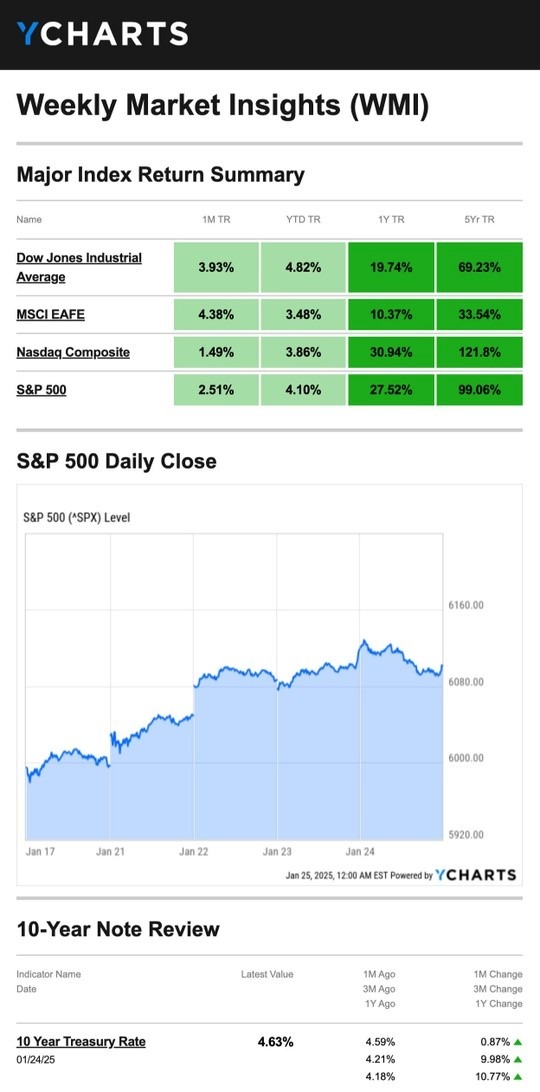
Source: YCharts.com, January 25, 2025. Weekly performance is measured from Friday, January 17, to Friday, January 24. TR = total return for the index, which includes any dividends as well as any other cash distributions during the period. Treasury note yield is expressed in basis points.
A Look Forward
The stock market is often described as a discounting mechanism, meaning current stock prices reflect everything we know today and even factor in expectations for the future. Last week, markets generally responded positively to news coming out of Washington. While some announcements sparked broad market rallies, others created more focused movements within specific sectors.⁶
For instance, on Thursday, investors cheered news that the White House believes interest rates are too high and would prefer to see them trend lower. This optimism came just ahead of the Fed’s first scheduled two-day policy meeting, which wraps up on Wednesday. All eyes will be on Fed Chair Jerome Powell to see if he addresses the administration’s concerns about rates and offers any clues about the Fed’s next steps.
Special Update: DeepSeek
DeepSeek, a Chinese AI startup, has announced the successful development of an advanced artificial intelligence model at an unprecedentedly low cost—less than $6 million.
This breakthrough has caught the attention of global investors and created ripples in the technology sector. Major players in AI, including those that rely heavily on expensive infrastructure, are seeing their stock values fluctuate as markets digest the news.
The Immediate Market Reaction
DeepSeek’s announcement has disrupted investor sentiment, especially among companies that have traditionally relied on high-cost AI development. Stocks of some well-known technology firms have experienced short-term declines, not necessarily because their fundamentals have changed, but due to market uncertainty about how they’ll adapt to this new competitive dynamic.
For long-term investors, it’s important to remember that short-term volatility in the markets is often driven by headlines rather than a reflection of fundamental value.
What This Means for the Technology Landscape
DeepSeek’s innovation represents a significant shift in how AI could be developed and deployed moving forward. Specifically:
- Cost Pressures on Incumbents: Traditional tech companies, especially those involved in developing AI hardware like GPUs and accelerators, may face pressure to innovate more efficiently or risk losing market share.
- Opportunities for Emerging Players: Low-cost AI could open doors for smaller, more agile companies to enter the AI space, creating fresh opportunities for growth.
- Accelerated Adoption of AI: By lowering the cost barrier, industries outside of tech, such as healthcare, education, and manufacturing, could adopt AI solutions faster, potentially fueling economic growth and innovation.
For investors, this means the technology sector may experience a shift in leadership, with winners being those who adapt to these changes and integrate cost-efficient AI into their operations.
The Week: Key Economic Data
Monday: New Home Sales.
Tuesday: Durable Goods. Consumer Confidence. Case-Shiller Home Price Index. Federal Open Market Committee (FOMC) meeting—Day 1.
Wednesday: FOMC meeting—Day 2. U.S. Trade Balance in Goods. Retail and Wholesale Inventories. FOMC announcement and Fed Chair Powell press conference.
Thursday: Gross Domestic Product (GDP). Pending Home Sales. Weekly Jobless Claims.
Friday: Personal Consumption & Expenditures (PCE) Index. Employment Cost Index. Fed Governor Michelle Bowman speaks.
Source: Investors Business Daily - Econoday economic calendar; January 24, 2025
The Econoday economic calendar lists upcoming U.S. economic data releases (including key economic indicators), Federal Reserve policy meetings, and speaking engagements of Federal Reserve officials. The content is developed from sources believed to be providing accurate information. The forecasts or forward-looking statements are based on assumptions and may not materialize. The forecasts also are subject to revision.
This Week: Companies Reporting Earnings
Monday: AT&T Inc. (T)
Tuesday: Starbucks Corporation (SBUX), The Boeing Company (BA), RTX Corporation (RTX), Stryker Corporation (SYK), Lockheed Martin Corporation (LMT), General Motors Company (GM)
Wednesday: Microsoft Corporation (MSFT), Meta Platforms, Inc. (META), Tesla, Inc. (TSLA), T-Mobile US, Inc. (TMUS), ServiceNow, Inc. (NOW), International Business Machines Corporation (IBM), Automatic Data Processing, Inc. (ADP)
Thursday: Apple Inc. (AAPL), Visa Inc. (V), Mastercard Incorporated (MA), Thermo Fisher Scientific Inc. (TMO), Caterpillar Inc. (CAT), Comcast Corporation (CMCSA), The Blackstone Group (BS), United Parcel Service, Inc. (UPS), Marsh & McLennan Companies, Inc. (MMC), Intel Corporation (INTC)
Friday: Exxon Mobil Corporation (XOM), AbbVie (ABBV), Chevron Corporation (CVX)
Source: Zacks, January 24, 2025. Companies mentioned are for informational purposes only. It should not be considered a solicitation for the purchase or sale of the securities. Investing involves risks, and investment decisions should be based on your own goals, time horizon, and tolerance for risk. The return and principal value of investments will fluctuate as market conditions change. When sold, investments may be worth more or less than their original cost. Companies may reschedule when they report earnings without notice.

“In a sense, one can never read the book that the author originally wrote, and one can never read the same book twice."
– Edmund Wilson

Melissa showed up at a business meeting fresh and alert, even though she had not slept a wink during any of the past four days. Why wasn’t she tired?
Last week's riddle: Dave is at the hardware store to buy something for his house. Yesterday, he bought 1 for $1. The week before, he purchased 10 for $2, and his friend bought 100 for $3. Today, he bought 907 for $3. If the prices haven’t changed, how is this possible?
Answer: Dave and his friend have been buying house numbers. 907 is $3 because it costs $1 per numeral.


Joanne's U11 basketball team rushing the offensive court.
Footnotes and Sources
- The Wall Street Journal, January 24, 2025
- Investing.com, January 24, 2025
- MarketWatch.com, January 21, 2025
- CNBC.com, January 22, 2025
- CNBC.com, January 24, 2025
- The Wall Street Journal, January 21, 2025
- IRS.gov, June 10, 2024
- Gardeners.com, October 3, 2024
Investing involves risks, and investment decisions should be based on your own goals, time horizon, and tolerance for risk. The return and principal value of investments will fluctuate as market conditions change. When sold, investments may be worth more or less than their original cost.
The forecasts or forward-looking statements are based on assumptions, may not materialize, and are subject to revision without notice.
The market indexes discussed are unmanaged, and generally, considered representative of their respective markets. Index performance is not indicative of the past performance of a particular investment. Indexes do not incur management fees, costs, and expenses. Individuals cannot directly invest in unmanaged indexes. Past performance does not guarantee future results.
The Dow Jones Industrial Average is an unmanaged index that is generally considered representative of large-capitalization companies on the U.S. stock market. Nasdaq Composite is an index of the common stocks and similar securities listed on the NASDAQ stock market and is considered a broad indicator of the performance of technology and growth companies. The MSCI EAFE Index was created by Morgan Stanley Capital International (MSCI) and serves as a benchmark of the performance of major international equity markets, as represented by 21 major MSCI indexes from Europe, Australia, and Southeast Asia. The S&P 500 Composite Index is an unmanaged group of securities that are considered to be representative of the stock market in general.
U.S. Treasury Notes are guaranteed by the federal government as to the timely payment of principal and interest. However, if you sell a Treasury Note prior to maturity, it may be worth more or less than the original price paid. Fixed income investments are subject to various risks including changes in interest rates, credit quality, inflation risk, market valuations, prepayments, corporate events, tax ramifications and other factors.
International investments carry additional risks, which include differences in financial reporting standards, currency exchange rates, political risks unique to a specific country, foreign taxes and regulations, and the potential for illiquid markets. These factors may result in greater share price volatility.
Please consult your financial professional for additional information.