


Last week, markets experienced some turbulence as tariff negotiations, January employment figures, and the final wave of Q4 earnings reports introduced volatility.
In the U.S., the S&P 500 dipped 0.24%, the Nasdaq Composite declined 0.53%, and the Dow Jones Industrial Average decreased by 0.54%. Internationally, the MSCI EAFE Index, which tracks developed overseas markets, edged up by 0.17%.
Here in Canada, the S&P/TSX Composite Index closed the week at 25,442.91, reflecting a slight decrease of approximately 0.36% from the previous week's close of 25,534.49.
The Canadian dollar traded at approximately 69.94 cents U.S., showing a modest increase from the previous week's 69.82 cents U.S.
Tariffs, Q4 Reports, and Jobs
Markets started the week on shaky ground as new tariffs on Mexico, Canada, and China kicked in over the weekend. But by mid-morning Monday, stocks bounced back after news broke of a U.S.-Mexico deal that put some trade rules on hold—followed shortly by a similar last-minute agreement with Canada.
By midweek, tech stocks took the lead, fueled by strong Q4 earnings reports from major players. The rally continued into Thursday, with the S&P 500 and Nasdaq notching their third straight day of gains. The Dow, however, slipped slightly as investors sifted through more earnings data.
Friday brought a bit of a reality check. A mixed jobs report and concerns about inflation weighed on markets, sending stocks lower to close out the week.
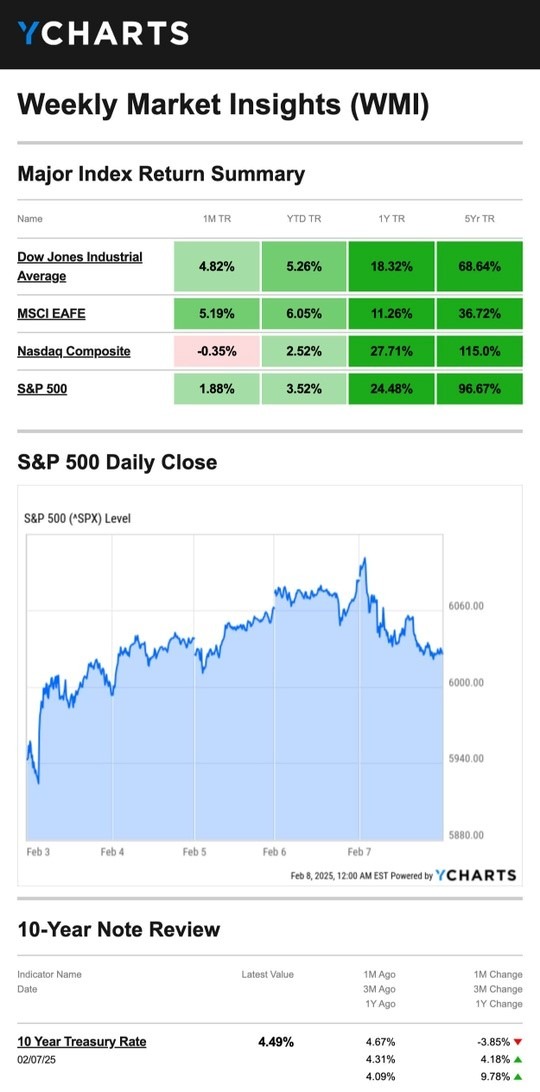
Source: YCharts.com, February 8, 2025. Weekly performance is measured from Monday, February 3, to Friday, February 7. TR = total return for the index, which includes any dividends as well as any other cash distributions during the period. Treasury note yield is expressed in basis points.
Mixed Signals on the Labour Market
If you’ve been following job reports over the past few years, you know they don’t always tell the same story—and last week was no exception.
On Friday, the Bureau of Labor Statistics reported that the U.S. added 143,000 jobs in January, the lowest monthly gain in four years. But earlier in the week, ADP’s private payroll report painted a different picture, showing 188,000 new jobs—well above the 150,000 economists had expected.
So, what’s behind the mixed signals? Economists point to several factors, including the difficulty of measuring January’s job market accurately. Seasonal layoffs after the holidays can skew the data, making it harder to get a clear read on the economy.
It’s a reminder that while job reports are important, they’re just one piece of the bigger economic puzzle.
This Week: Key Economic Data
Tuesday: Cleveland Fed President Beth Hammack and New York Fed President John Williams speak.
Wednesday: Consumer Price Index (CPI). Atlanta Fed President Raphael Bostic speaks. Federal budget.
Thursday: Weekly Jobless Claims. Producer Price Index (PPI).
Friday: Import Price Index. Retail Sales. Industrial Production. Business Inventories.
Source: Investors Business Daily - Econoday economic calendar; February 7, 2025
The Econoday economic calendar lists upcoming U.S. economic data releases (including key economic indicators), Federal Reserve policy meetings, and speaking engagements of Federal Reserve officials. The content is developed from sources believed to be providing accurate information. The forecasts or forward-looking statements are based on assumptions and may not materialize. The forecasts also are subject to revision.
This Week: Companies Reporting Earnings
Monday: McDonald’s Corporation (MCD), Vertex Pharmaceuticals Incorporated (VRTX)
Tuesday: The CocaCola Company (KO), S&P Global Inc. (SPGI), Shopify Inc. (SHOP), Gilead Sciences, Inc. (GILD)
Wednesday: Cisco Systems, Inc. (CSCO), AppLovin Corporation (APP)
Thursday: Applied Materials, Inc. (AMAT), Deere & Company (DE), Palo Alto Networks, Inc. (PANW), Brookfield Corporation (BN), Moody’s Corporation (MCO)
Source: Zacks, February 7, 2025. Companies mentioned are for informational purposes only. It should not be considered a solicitation for the purchase or sale of the securities. Investing involves risks, and investment decisions should be based on your own goals, time horizon, and tolerance for risk. The return and principal value of investments will fluctuate as market conditions change. When sold, investments may be worth more or less than their original cost. Companies may reschedule when they report earnings without notice.

"Understanding is a two-way street."
- Eleanor Roosevelt

"Each Morning, I show up at your feet, yet at midday, I nearly retreat. No matter how fast you move, I follow. What am I?"
Last week's riddle: Melissa showed up at a business meeting fresh and alert, even though she had not slept a wink during any of the past four days. Why wasn’t she tired?
Answer: She had slept during the past four nights.


Joanne's dog, Taz, living his best life!
Footnotes and Sources
- The Wall Street Journal, February 7, 2025
- Investing.com, February 7, 2025
- The Wall Street Journal, February 3, 2025
- CNBC.com, February 4, 2025
- CNBC.com, February 5, 2025
- The Wall Street Journal, February 6, 2025
- The Wall Street Journal, February 7, 2025
- MarketWatch.com, February 4, 2025
- MarketWatch.com, February 5, 2025
- The Wall Street Journal, February 7, 2025
- IRS.gov, February 23, 2024
- Healthline, October 3, 2024
Investing involves risks, and investment decisions should be based on your own goals, time horizon, and tolerance for risk. The return and principal value of investments will fluctuate as market conditions change. When sold, investments may be worth more or less than their original cost.
The forecasts or forward-looking statements are based on assumptions, may not materialize, and are subject to revision without notice.
The market indexes discussed are unmanaged, and generally, considered representative of their respective markets. Index performance is not indicative of the past performance of a particular investment. Indexes do not incur management fees, costs, and expenses. Individuals cannot directly invest in unmanaged indexes. Past performance does not guarantee future results.
The Dow Jones Industrial Average is an unmanaged index that is generally considered representative of large-capitalization companies on the U.S. stock market. Nasdaq Composite is an index of the common stocks and similar securities listed on the NASDAQ stock market and is considered a broad indicator of the performance of technology and growth companies. The MSCI EAFE Index was created by Morgan Stanley Capital International (MSCI) and serves as a benchmark of the performance of major international equity markets, as represented by 21 major MSCI indexes from Europe, Australia, and Southeast Asia. The S&P 500 Composite Index is an unmanaged group of securities that are considered to be representative of the stock market in general.
U.S. Treasury Notes are guaranteed by the federal government as to the timely payment of principal and interest. However, if you sell a Treasury Note prior to maturity, it may be worth more or less than the original price paid. Fixed income investments are subject to various risks including changes in interest rates, credit quality, inflation risk, market valuations, prepayments, corporate events, tax ramifications and other factors.
International investments carry additional risks, which include differences in financial reporting standards, currency exchange rates, political risks unique to a specific country, foreign taxes and regulations, and the potential for illiquid markets. These factors may result in greater share price volatility.
Please consult your financial professional for additional information.