


Last week, global stock markets experienced declines amid concerns about persistent inflation and economic growth. The Standard & Poor’s 500 Index fell by 1.66%, the Nasdaq Composite Index dropped 2.51%, and the Dow Jones Industrial Average also decreased by 2.51%. The MSCI EAFE Index, which tracks developed overseas stock markets, remained relatively flat with a slight increase of 0.04%.
In Canada, the S&P/TSX Composite Index faced similar challenges. On Friday, February 21, the index declined by 0.44%, closing at 25,513.61 points. Despite this, it was on track for a modest 0.1% weekly gain. The healthcare sector stood out with a 4.3% gain, while the technology sector faced challenges, losing 2.9% and emerging as the week's weakest performer. Reuters
Looking ahead, futures for Canada's main stock index rose by 0.54% on Monday, February 24, buoyed by higher gold prices amid a weaker U.S. dollar. This uptick followed a major sell-off in the previous session. Investors are also anticipating key economic data releases, including the U.S. Federal Reserve's core inflation measure and Canada's fourth-quarter GDP numbers, both due on Friday.
S&P 500 Hit New High, Then Slips
After the Presidents’ Day holiday, the stock market was a bit of a rollercoaster on Tuesday, with prices mostly staying in a range, though there was some volatility during the day. Investors seemed to shake off the news of new tariff discussions and some disappointing housing start data. By Wednesday, things had settled down, and the S&P 500 ended the day with its third record close of the year, a nice little win for investors.
However, Thursday brought some tension. Stocks took a hit right out of the gate, spooked by a weaker-than-expected outlook from a major retailer. It didn’t help that this update raised concerns that the economy might be slowing down. Things got even worse on Friday. The market tumbled after a consumer sentiment survey revealed that investors were feeling uneasy about inflation. It turned out to be the worst day of the year so far.
All in all, it was a week of ups and downs, with the market ultimately reflecting the broader economic uncertainty. It’s a reminder that staying informed and adaptable is key in this ever-changing environment.
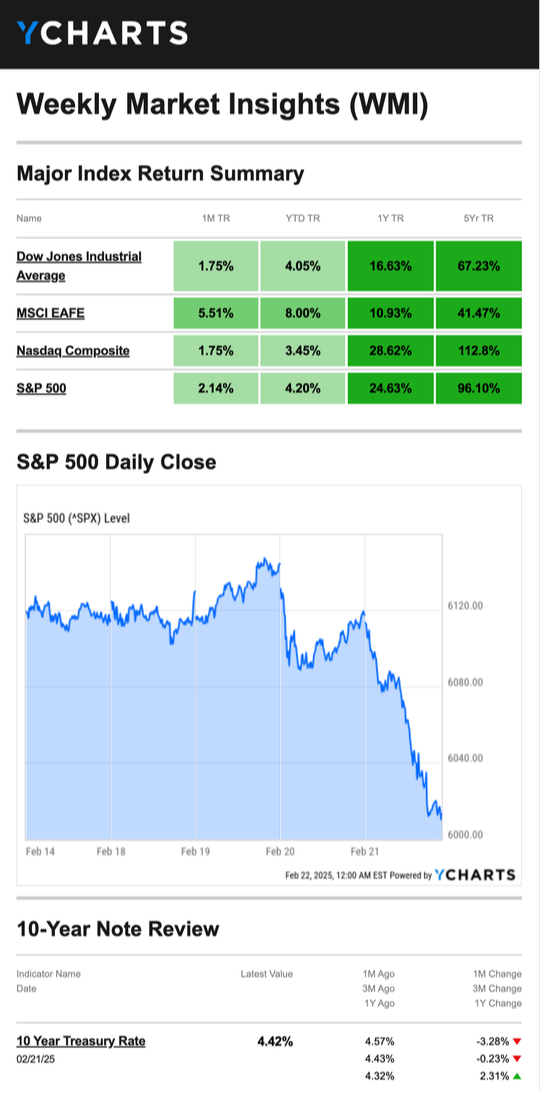
Source: YCharts.com, February 22, 2025. Weekly performance is measured from Friday, February 14, to Friday, February 21. TR = total return for the index, which includes any dividends as well as any other cash distributions during the period. Treasury note yield is expressed in basis points.
Economic Jitters
It was a tough week for investors, as the market was hit with some unsettling news about the economy and inflation. It all started when traders were caught off guard by a slowdown in demand from the country’s biggest retailer. This news put a damper on the outlook for consumers and, by extension, the broader economy. To make matters worse, the University of Michigan’s Consumer Confidence survey dropped by 10% in February, with consumers clearly worried about rising inflation and the looming threat of new tariffs.
With these concerns weighing heavily on their minds, many investors took a step back and decided to play it safe, moving into a "risk-off" position as they headed into the weekend. It’s a reminder of how quickly market sentiment can shift, especially when there’s uncertainty in the air.
This Week: Key Economic Data
Tuesday: Consumer Confidence. Fed Officials Lorie Logan and Thomas Barkin speak.
Wednesday: New Home Sales. Fed Officials Thomas Barkin and Raphael Bostic speak.
Thursday: Gross Domestic Product (GDP). Durable Goods. Weekly Jobless Claims. Pending Home Sales. Fed Balance Sheet.
Friday: Personal Consumption and Expenditures (PCE) Index.
Source: Investors Business Daily - Econoday economic calendar; February 21, 2025
The Econoday economic calendar lists upcoming U.S. economic data releases (including key economic indicators), Federal Reserve policy meetings, and speaking engagements of Federal Reserve officials. The content is developed from sources believed to be providing accurate information. The forecasts or forward-looking statements are based on assumptions and may not materialize. The forecasts also are subject to revision.
This Week: Companies Reporting Earnings
Tuesday: The Home Depot, Inc. (HD), Intuit Inc. (INTU)
Wednesday: NVIDIA Corporation (NVDA), Salesforce Inc. (CRM), Lowe’s Companies, Inc. (LOW), The TJX Companies, Inc. (TJX)
Thursday: Dell Technologies Inc. (DELL)
Friday: Berkshire Hathaway Inc. (BRK.A,BRK.B)
Source: Zacks, February 21, 2025. Companies mentioned are for informational purposes only. It should not be considered a solicitation for the purchase or sale of the securities. Investing involves risks, and investment decisions should be based on your own goals, time horizon, and tolerance for risk. The return and principal value of investments will fluctuate as market conditions change. When sold, investments may be worth more or less than their original cost. Companies may reschedule when they report earnings without notice.

“One person practicing sportsmanship is far better than 50 preaching it."
– Knute Rockne

"I have rosy cheeks, I am round and cute – yet debate persists over whether I am vegetable or fruit. What might I be?"
Last week's riddle: Each Morning, I show up at your feet, yet at midday, I nearly retreat. No matter how fast you move, I follow. What am I?
Answer: Your shadow


Joanne's dogs, Taz and Austin, doing what they do best...Sleep!
Footnotes and Sources
- The Wall Street Journal, February 21, 2025
- Investing.com, February 21, 2025
- CNBC.com, February 18, 2025
- The Wall Street Journal, February 19, 2025
- CNBC.com, February 21, 2025
- The Wall Street Journal, February 21, 2025
- IRS.gov, April 11, 2024
- Mindful, October 3, 2024
Investing involves risks, and investment decisions should be based on your own goals, time horizon, and tolerance for risk. The return and principal value of investments will fluctuate as market conditions change. When sold, investments may be worth more or less than their original cost.
The forecasts or forward-looking statements are based on assumptions, may not materialize, and are subject to revision without notice.
The market indexes discussed are unmanaged, and generally, considered representative of their respective markets. Index performance is not indicative of the past performance of a particular investment. Indexes do not incur management fees, costs, and expenses. Individuals cannot directly invest in unmanaged indexes. Past performance does not guarantee future results.
The Dow Jones Industrial Average is an unmanaged index that is generally considered representative of large-capitalization companies on the U.S. stock market. Nasdaq Composite is an index of the common stocks and similar securities listed on the NASDAQ stock market and is considered a broad indicator of the performance of technology and growth companies. The MSCI EAFE Index was created by Morgan Stanley Capital International (MSCI) and serves as a benchmark of the performance of major international equity markets, as represented by 21 major MSCI indexes from Europe, Australia, and Southeast Asia. The S&P 500 Composite Index is an unmanaged group of securities that are considered to be representative of the stock market in general.
U.S. Treasury Notes are guaranteed by the federal government as to the timely payment of principal and interest. However, if you sell a Treasury Note prior to maturity, it may be worth more or less than the original price paid. Fixed income investments are subject to various risks including changes in interest rates, credit quality, inflation risk, market valuations, prepayments, corporate events, tax ramifications and other factors.
International investments carry additional risks, which include differences in financial reporting standards, currency exchange rates, political risks unique to a specific country, foreign taxes and regulations, and the potential for illiquid markets. These factors may result in greater share price volatility.
Please consult your financial professional for additional information.