


Investors faced yet another rollercoaster week as ongoing trade negotiations and mixed signals from the White House kept markets on edge. Volatility remained front and center, leaving many wondering what’s next for the economy.
In the U.S., the major indices all saw significant declines. The S&P 500 dropped 2.27%, the Nasdaq fell 2.43%, and the Dow Jones Industrial Average took the biggest hit, sliding 3.07%. International markets weren’t spared either, with the MSCI EAFE Index—tracking developed markets outside North America—losing 0.95%.
Closer to home, the TSX also felt the pressure, swinging through another turbulent week as investors reacted to shifting trade headlines and economic uncertainty. With global markets searching for direction, Canadian investors are keeping a close eye on how trade developments and economic signals will shape the road ahead.
Markets Stem Losses
Stocks started the week on shaky ground after the U.S. president’s comments about the economy rattled markets. Adding to the turbulence, U.S. and Canadian leaders exchanged fresh tariff threats, further unsettling investors and raising concerns about trade stability. The TSX, already under pressure from global market uncertainty, felt the impact as well.
By midweek, markets found some relief when a cooler-than-expected U.S. Consumer Price Index (CPI) report eased inflation fears. In Canada, inflation remains a key concern, with the Bank of Canada carefully watching price trends amid expectations for future interest rate moves.
However, the relief was short-lived. On Thursday, markets slid once again, and the S&P 500 officially entered correction territory—down 10% from its February 19 record close. But there was a silver lining: better-than-expected U.S. wholesale inflation data helped soften the blow.
By Friday, markets staged a modest comeback. Investors welcomed news of progress in resolving the U.S. federal government shutdown, which had been adding to economic uncertainty. Meanwhile, the TSX clawed back some of its losses, though concerns over trade and commodity prices continue to weigh on Canadian markets.
With trade negotiations ongoing and inflation remaining a central focus, investors will be watching closely to see how markets respond in the weeks ahead.
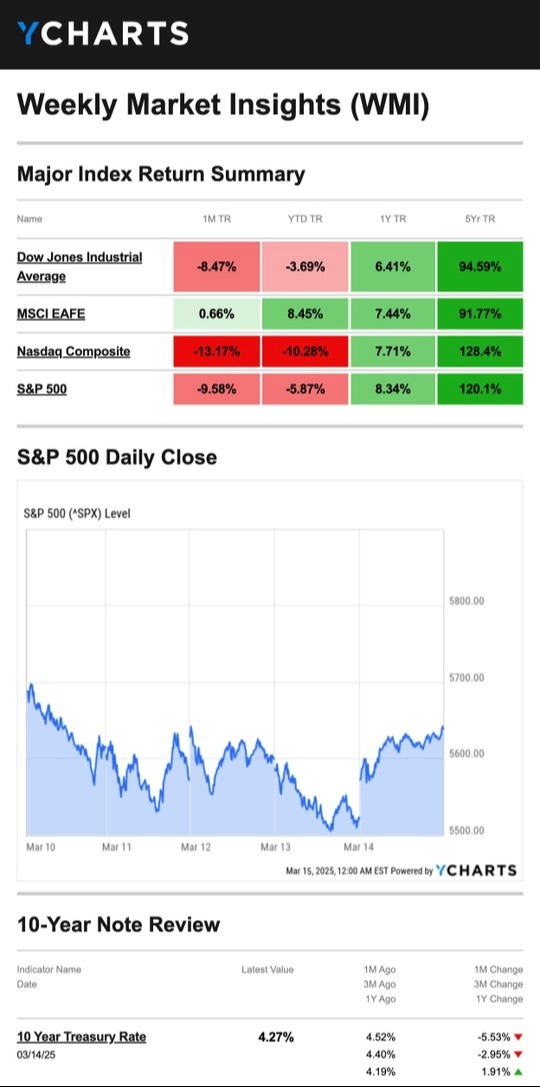
Source: YCharts.com, March 15, 2025. Weekly performance is measured from Monday, March 10, to Friday, March 14. TR = total return for the index, which includes any dividends as well as any other cash distributions during the period. Treasury note yield is expressed in basis points.
Sunny Side 'Down'
Of all the items in your grocery cart, few have sparked more conversation lately than the price of eggs. It’s no surprise—after all, when prices jump 15% in January and another 10% in February, people notice. The main culprit? Avian flu, which led to the culling of millions of chickens and sent egg prices soaring. While recent reports suggest prices have started to ease, eggs remain a hot topic at the checkout line.
But why are we so fixated on eggs when so many other essentials have gone up in price too?
One theory is that eggs represent something bigger. They’re a staple in almost every household, an affordable source of protein, and a key ingredient in everything from homemade breakfasts to mass-produced foods. When egg prices spike, it’s a direct hit to the grocery budget—and a reminder that inflation is still a very real issue. In many ways, eggs have become a symbol of how people feel about the economy overall.
Whether prices continue to settle or not, one thing is clear: the cost of eggs isn’t just about breakfast—it’s about confidence in our wallets and the economy.
This Week: Key Economic Data
Monday: Retail Sales. Business Inventories. Homebuilder Confidence Index.
Tuesday: Housing Starts and Permits. Import & Export Prices. Industrial Production. Capacity Utilization. Federal Open Market Committee (FOMC) meeting—Day 1.
Wednesday: FOMC meeting—Day 2. Fed Announcement/ Fed Chair Press Conference.
Thursday: Existing Home Sales. Weekly Jobless Claims. Leading Indicators.
Friday: Federal Reserve Official John Williams speaks.
Source: Investors Business Daily - Econoday economic calendar; March 13, 2025
The Econoday economic calendar lists upcoming U.S. economic data releases (including key economic indicators), Federal Reserve policy meetings, and speaking engagements of Federal Reserve officials. The content is developed from sources believed to be providing accurate information. The forecasts or forward-looking statements are based on assumptions and may not materialize. The forecasts also are subject to revision.
This Week: Companies Reporting Earnings
Wednesday: General Mills, Inc. (GIS)
Thursday: Nike, Inc. (NKE), Micron Technology, Inc. (MU), FedEx Corporation (FDX)
Source: Zacks, March 13, 2025. Companies mentioned are for informational purposes only. It should not be considered a solicitation for the purchase or sale of the securities. Investing involves risks, and investment decisions should be based on your own goals, time horizon, and tolerance for risk. The return and principal value of investments will fluctuate as market conditions change. When sold, investments may be worth more or less than their original cost. Companies may reschedule when they report earnings without notice.

“It takes 20 years to build a reputation and five minutes to ruin it."
– Warren Buffett

I twist, I turn, but I don’t have curves. You can twist me to fix me, but you may throw me into disarray in the process. Hours later, you may cast me away. What am I?
Last week’s riddle: What binds two people together yet touches only one person at a time?
Answer: An individual wedding ring.


The Butterfly Garden' in Victoria.
Footnotes and Sources
1. The Wall Street Journal, March 14, 2025
2. Investing.com, March 14, 2025
3. The Wall Street Journal, March 10, 2025
4. CNBC.com, March 11, 2025
5. CNBC.com, March 12, 2025
6. CNBC.com, March 12, 2025
7. The Wall Street Journal, March 14, 2025
8. MarketWatch.com, March 12, 2025
9. Newsweek, March 11, 2025
10. MarketWatch.com, March 10, 2025
11. IRS.gov, April 3, 2024
12. Inspired Taste, October 3, 2024
Investing involves risks, and investment decisions should be based on your own goals, time horizon, and tolerance for risk. The return and principal value of investments will fluctuate as market conditions change. When sold, investments may be worth more or less than their original cost.
The forecasts or forward-looking statements are based on assumptions, may not materialize, and are subject to revision without notice.
The market indexes discussed are unmanaged, and generally, considered representative of their respective markets. Index performance is not indicative of the past performance of a particular investment. Indexes do not incur management fees, costs, and expenses. Individuals cannot directly invest in unmanaged indexes. Past performance does not guarantee future results.
The Dow Jones Industrial Average is an unmanaged index that is generally considered representative of large-capitalization companies on the U.S. stock market. Nasdaq Composite is an index of the common stocks and similar securities listed on the NASDAQ stock market and is considered a broad indicator of the performance of technology and growth companies. The MSCI EAFE Index was created by Morgan Stanley Capital International (MSCI) and serves as a benchmark of the performance of major international equity markets, as represented by 21 major MSCI indexes from Europe, Australia, and Southeast Asia. The S&P 500 Composite Index is an unmanaged group of securities that are considered to be representative of the stock market in general.
U.S. Treasury Notes are guaranteed by the federal government as to the timely payment of principal and interest. However, if you sell a Treasury Note prior to maturity, it may be worth more or less than the original price paid. Fixed income investments are subject to various risks including changes in interest rates, credit quality, inflation risk, market valuations, prepayments, corporate events, tax ramifications and other factors.
International investments carry additional risks, which include differences in financial reporting standards, currency exchange rates, political risks unique to a specific country, foreign taxes and regulations, and the potential for illiquid markets. These factors may result in greater share price volatility.
Please consult your financial professional for additional information.