


Stocks moved lower last week as renewed fiscal concerns and escalating tariff threats weighed on investor sentiment. The S&P 500 declined by 2.61%, the Nasdaq Composite fell 2.47%, and the Dow Jones Industrial Average also lost 2.47%. Overseas, the MSCI EAFE Index, which tracks developed international markets, posted a 1.14% gain. In Canada, the S&P/TSX Composite Index edged down reflecting broader global caution.
Market Under Pressure
The week began with headwinds after Moody’s downgraded the U.S. credit outlook, citing rising fiscal risks. This development pressured markets early on, as investors reassessed the risk landscape.
Midweek, selling pressure continued as Treasury yields rose, with the 30-year bond yield hitting a 19-month high. Concerns about the growing U.S. budget deficit gained traction, especially with a new spending bill moving through Congress. Yields later eased after the House passed the bill, and markets stabilized somewhat.
Tariff Fears Reignite
On Friday, markets dipped again after President Trump floated the idea of a 50% tariff on European Union goods, citing stalled trade talks. Additionally, the administration threatened a 25% tariff on iPhones produced outside the U.S., raising concerns about further disruption to global supply chains.
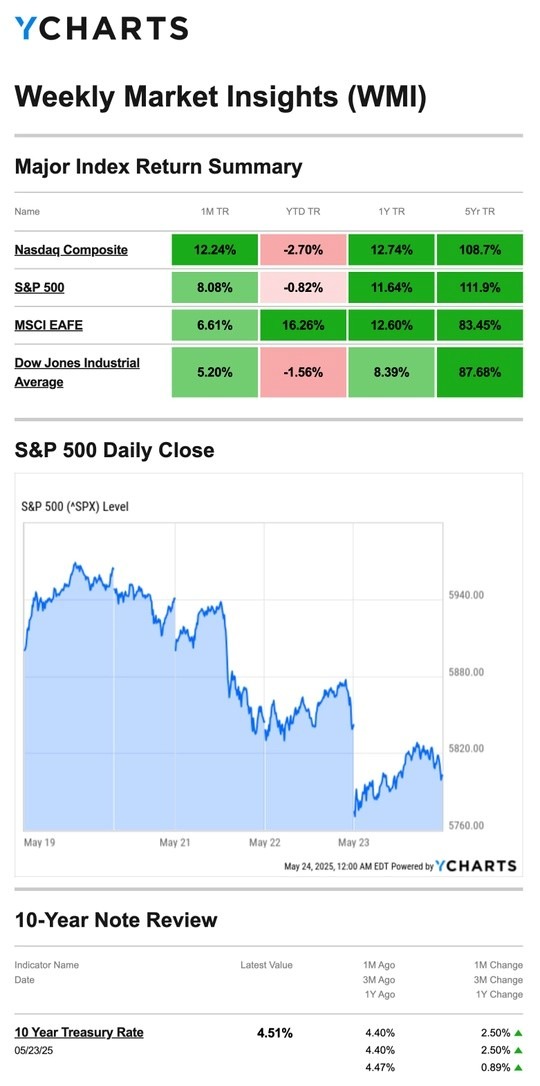
Source: YCharts.com, May 24, 2025. Weekly performance is measured from Monday, May 19, to Friday, May 23. TR = total return for the index, which includes any dividends as well as any other cash distributions during the period. Treasury note yield is expressed in basis points.
Unexpected Tariff News...Again
The President’s renewed tariff threats disrupted a brief period of calm on the trade front. While the proposed tariffs on European Union goods could ultimately be resolved through a deal—similar to past agreements with other nations—the issue surrounding iPhones may be more complex.
Some analysts estimate that shifting iPhone production to the U.S. could raise manufacturing costs by up to 50%, potentially leading to higher consumer prices.
This Week: Key Economic Data
Monday: Market Holiday
Tuesday: Durable Goods. New York Fed President John Williams and Minneapolis Fed President Neel Kashkari speak. Case-Shiller Home Price Index. Consumer Confidence.
Wednesday: Federal Open Market Committee (FOMC) Meeting Minutes. Neel Kashkari speaks.
Thursday: Gross Domestic Product (GDP). Jobless Claims (weekly). San Francisco Fed President Mary Daly and Chicago Fed President Austan Goolsbee speak. Fed Balance Sheet. Pending Home Sales.
Friday: Personal Consumption & Expenditures (PCE) Index. International Trade Balance in Goods. Atlanta Fed President Raphael Bostic and Austan Goolsbee speak. Retail and Wholesale Inventories. Consumer Sentiment.
Source: Investors Business Daily - Econoday economic calendar; May 23, 2025
The Econoday economic calendar lists upcoming U.S. economic data releases (including key economic indicators), Federal Reserve policy meetings, and speaking engagements of Federal Reserve officials. The content is developed from sources believed to be providing accurate information. The forecasts or forward-looking statements are based on assumptions and may not materialize. The forecasts also are subject to revision.
This Week: Companies Reporting Earnings
Wednesday: NVIDIA Corporation (NVDA), Salesforce Inc. (CRM)
Thursday: Costco Wholesale Corporation (COST), Dell Technologies Inc. (DELL)
Source: Zacks, May 23, 2025. Companies mentioned are for informational purposes only. It should not be considered a solicitation for the purchase or sale of the securities. Investing involves risks, and investment decisions should be based on your own goals, time horizon, and tolerance for risk. The return and principal value of investments will fluctuate as market conditions change. When sold, investments may be worth more or less than their original cost. Companies may reschedule when they report earnings without notice.

"You can’t destroy knowledge. You can stamp it under and burn it up and forbid it to be, but somewhere it will survive."
– Leigh Brackett

It has dozens of fine teeth, but you can hold it in your hand, and it will never bite you. What is it?
Last week's riddle: What can go down a chimney when it is down but can’t go up through a chimney when it is up?
Answer: An umbrella


Taz, is never too far away...even when I am eating dinner.
Footnotes and Sources
1. WSJ.com, May 23, 2025
2. Investing.com, May 23, 2025
3. CNBC.com, May 19, 2025
4. CNBC.com, May 20, 2025
5. CNBC.com, May 21, 2025
6. CNBC.com, May 22, 2025
7. WSJ.com, May 23, 2025
8. MarketWatch.com, May 23, 2025
9. IRS.gov, August 20, 2024
10. CDC.gov, December 12, 2024
Investing involves risks, and investment decisions should be based on your own goals, time horizon, and tolerance for risk. The return and principal value of investments will fluctuate as market conditions change. When sold, investments may be worth more or less than their original cost.
The forecasts or forward-looking statements are based on assumptions, may not materialize, and are subject to revision without notice.
The market indexes discussed are unmanaged, and generally, considered representative of their respective markets. Index performance is not indicative of the past performance of a particular investment. Indexes do not incur management fees, costs, and expenses. Individuals cannot directly invest in unmanaged indexes. Past performance does not guarantee future results.
The Dow Jones Industrial Average is an unmanaged index that is generally considered representative of large-capitalization companies on the U.S. stock market. Nasdaq Composite is an index of the common stocks and similar securities listed on the NASDAQ stock market and is considered a broad indicator of the performance of technology and growth companies. The MSCI EAFE Index was created by Morgan Stanley Capital International (MSCI) and serves as a benchmark of the performance of major international equity markets, as represented by 21 major MSCI indexes from Europe, Australia, and Southeast Asia. The S&P 500 Composite Index is an unmanaged group of securities that are considered to be representative of the stock market in general.
U.S. Treasury Notes are guaranteed by the federal government as to the timely payment of principal and interest. However, if you sell a Treasury Note prior to maturity, it may be worth more or less than the original price paid. Fixed income investments are subject to various risks including changes in interest rates, credit quality, inflation risk, market valuations, prepayments, corporate events, tax ramifications and other factors.
International investments carry additional risks, which include differences in financial reporting standards, currency exchange rates, political risks unique to a specific country, foreign taxes and regulations, and the potential for illiquid markets. These factors may result in greater share price volatility.
Please consult your financial professional for additional information.