


Markets bounced back last week, lifted by positive economic data and some cooling off in trade tensions between the U.S. and China.
The S&P 500 gained 1.50% and broke back above the 6,000 mark, a level it hadn’t seen since February. The Nasdaq rose 2.18%, powered by strong performances from major tech companies—especially those tied to artificial intelligence. The Dow Jones added 1.17%, and even overseas markets had a good week, with the MSCI EAFE Index (which tracks developed international markets) up 0.78%.
Here in Canada, the TSX Composite Index ended the week higher as well, gaining about 0.9%. Energy and financial stocks helped push the index upward.
What Moved the Market
Early in the week, investors were feeling optimistic. Hopes for progress on U.S.-China trade talks and a solid economic outlook helped boost sentiment. Big tech stocks, especially AI chipmakers, led the charge.
Midweek, things hit a bit of a bump. Tariff concerns re-emerged, and one major tech stock took a hit, which slowed the rally temporarily. But by Friday, the markets were back in full swing.
The catalyst? A stronger-than-expected U.S. jobs report. The economy added 139,000 jobs in May, beating expectations of 125,000. That gave investors confidence that the economy is still chugging along without overheating.
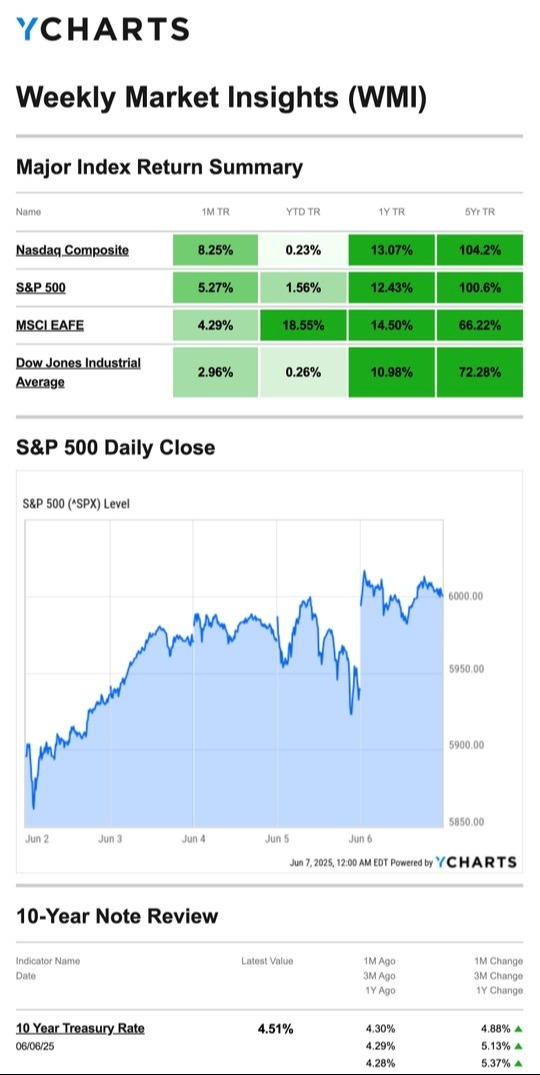
Source: YCharts.com, June 7, 2025. Weekly performance is measured from Monday, June 2, to Friday, June 6. TR = total return for the index, which includes any dividends as well as any other cash distributions during the period. Treasury note yield is expressed in basis points.
Jobs & Trade
Despite all the noise in the headlines, markets moved higher again last week. Here are three key reasons why:
- Strong Jobs Report: The latest U.S. jobs report came in better than expected, helping calm some worries about the economy slowing down.
- Steady Unemployment & Rising Wages: The unemployment rate stayed at 4.2%, and wages grew 3.9% over the past year. Those numbers suggest the job market remains solid.
- Progress on Trade: Even with some political back-and-forth, trade talks moved forward. The U.S. reached a new deal with Germany and continued making progress with China.
What to Watch This Week: Key Economic Updates
Here's a quick look at some important economic data coming out this week:
- Monday: Wholesale Inventories
- Tuesday: Small Business Optimism Index (NFIB)
- Wednesday: Consumer Price Index (CPI), Federal Budget update, and the 10-Year Treasury auction
- Thursday: Weekly Jobless Claims, Producer Price Index (PPI), and the 30-Year Treasury auction
- Friday: Consumer Sentiment report
These reports give investors a clearer picture of where the economy might be headed—and could move markets depending on the results.
Source: Investors Business Daily - Econoday Economic Calendar, June 6, 2025
Earnings to Keep an Eye On
Just a couple of big-name companies reporting earnings this week:
- Wednesday: Oracle (ORCL)
- Thursday: Adobe (ADBE)
Source: Zacks, June 6, 2025. Mentioned companies are for informational purposes only—not investment advice. As always, investing involves risk and decisions should reflect your personal financial goals and risk tolerance.

“The road less traveled is sometimes fraught with barricades, bumps, and uncharted terrain. But it is on that road where your character is truly tested.”
– Katie Couric

Three playing cards lie face down on a table. A jack is to the left of a queen. To the left of a spade is a diamond. A king is left of a heart. A spade is right of a king. What are the three cards?
Last week's riddle: It has dozens of fine teeth, but you can hold it in your hand, and it will never bite you. What is it?
Answer: A gear


Melissa's dogs, Benson and Jaco, just being cute.
Footnotes and Sources
1. WSJ.com, June 6, 2025
2. Investing.com, June 6, 2025
3. CNBC.com, June 3, 2025
4. CNBC.com, June 5, 2025
5. MarketWatch.com, June 5, 2025
6. MarketWatch.com, June 6, 2025
7. WSJ.com, June 6, 2025
8. MarketWatch.com, June 6, 2025
9. IRS.gov, September 20, 2024
10. Very Well Fit, December 12, 2024
Investing involves risks, and investment decisions should be based on your own goals, time horizon, and tolerance for risk. The return and principal value of investments will fluctuate as market conditions change. When sold, investments may be worth more or less than their original cost.
The forecasts or forward-looking statements are based on assumptions, may not materialize, and are subject to revision without notice.
The market indexes discussed are unmanaged, and generally, considered representative of their respective markets. Index performance is not indicative of the past performance of a particular investment. Indexes do not incur management fees, costs, and expenses. Individuals cannot directly invest in unmanaged indexes. Past performance does not guarantee future results.
The Dow Jones Industrial Average is an unmanaged index that is generally considered representative of large-capitalization companies on the U.S. stock market. Nasdaq Composite is an index of the common stocks and similar securities listed on the NASDAQ stock market and is considered a broad indicator of the performance of technology and growth companies. The MSCI EAFE Index was created by Morgan Stanley Capital International (MSCI) and serves as a benchmark of the performance of major international equity markets, as represented by 21 major MSCI indexes from Europe, Australia, and Southeast Asia. The S&P 500 Composite Index is an unmanaged group of securities that are considered to be representative of the stock market in general.
U.S. Treasury Notes are guaranteed by the federal government as to the timely payment of principal and interest. However, if you sell a Treasury Note prior to maturity, it may be worth more or less than the original price paid. Fixed income investments are subject to various risks including changes in interest rates, credit quality, inflation risk, market valuations, prepayments, corporate events, tax ramifications and other factors.
International investments carry additional risks, which include differences in financial reporting standards, currency exchange rates, political risks unique to a specific country, foreign taxes and regulations, and the potential for illiquid markets. These factors may result in greater share price volatility.
Please consult your financial professional for additional information.