


Last week was quite a ride in the markets, wasn’t it? With fresh economic data coming in and some election-related uncertainty swirling around, it felt like a mixed bag for investors. The Standard & Poor’s 500 Index dipped by 0.96%, while the Nasdaq Composite managed a small gain of 0.16%. The Dow Jones Industrial Average took a bigger hit, dropping 2.68%. Meanwhile, the MSCI EAFE Index, which looks at developed overseas markets, slid down by 2.30%.
Over in Canada, the TSX faced its own challenges. The index experienced some volatility but ultimately closed the week slightly lower, reflecting concerns over global economic conditions and energy prices. It’s a reminder of how interconnected our markets are, and it will be interesting to see how things unfold in the coming weeks.
How did you feel about the market movements? It's always tough to navigate through times like these, but staying informed can help us make better decisions!
Bank of Canada Cuts Rates - Again
Last week, the Bank of Canada continued cutting interest rates (50 basis points), and it definitely caught my attention. This decision aims to give a boost to the economy, especially as we face some uncertainty and challenges. Lower rates mean cheaper borrowing costs for things like mortgages and loans, which could help both consumers and businesses. For those of us with loans, it might be a bit of relief, making monthly payments more manageable.
Nasdaq Leads
This past week felt a bit mixed for the markets, didn’t it? As investors prepared for a wave of Q3 earnings reports, there was a sense of anticipation in the air. It’s always interesting to see how different companies perform, especially in this economic climate. The 10-year Treasury yield kept climbing, which had some traders on edge—always a good reminder of how interconnected everything is.
Wednesday morning hit hard with the news that existing home sales in the U.S. dropped to a 14-year low in October. It’s tough out there, especially with higher interest rates weighing on the market. It really puts things into perspective when you think about how this year is shaping up to be the worst for home sales since 1995! And with pre-election jitters lingering, it felt like a lot was hanging in the balance.
On a brighter note, news that durable goods orders rose in September brought a little cheer, which was nice to see. By Friday’s close, the Nasdaq, powered by tech stocks, celebrated its seventh consecutive week of gains—what a streak! Meanwhile, the S&P 500 broke its six-week winning run, reminding us how quickly things can shift.
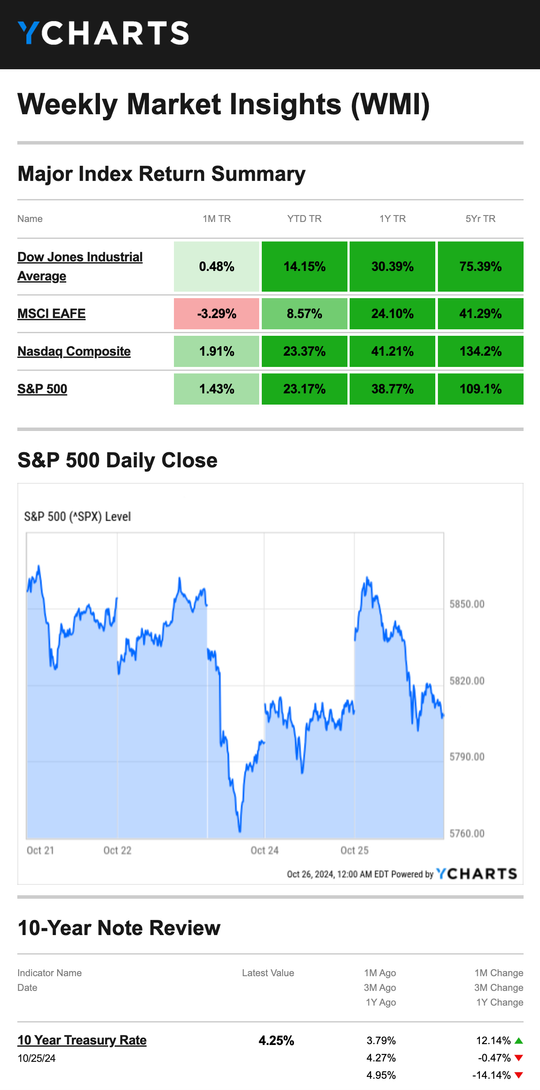
Source: YCharts.com, October 26, 2024. Weekly performance is measured from Monday, October 21, to Friday, October 25. TR = total return for the index, which includes any dividends as well as any other cash distributions during the period. Treasury note yield is expressed in basis points.
Election Focus
With the election cycle heating up, I can really sense a shift in the market mood. It seems like some traders are bracing themselves for more volatility in the weeks ahead. Back in late August, things were looking pretty optimistic, with nearly 90% of stocks trading above their 20-day moving average. But lately, that momentum has definitely slowed down.
Just this past Tuesday, Standard & Poor’s reported that the number of stocks above that same average has dropped to around 50%. It feels like many are shifting into a more cautious, or “risk off,” mindset as we approach November 5. It’s interesting to see how these events can impact trading behavior, isn’t it?
This Week: Key Economic Data
Tuesday: International Trade in Goods. Consumer Confidence. Case-Shiller Home Price Index.
Wednesday: Gross Domestic Product. Treasury Refunding Announcement. Pending Home Sales. ADP Employment Report.
Thursday: Personal Income and Outlays.
Friday: Employment Situation. ISM Manufacturing Index.
Source: Investors Business Daily - Econoday economic calendar; October 25, 2024
The Econoday economic calendar lists upcoming U.S. economic data releases (including key economic indicators), Federal Reserve policy meetings, and speaking engagements of Federal Reserve officials. The content is developed from sources believed to be providing accurate information. The forecasts or forward-looking statements are based on assumptions and may not materialize. The forecasts also are subject to revision.
This Week: Companies Reporting Earnings
Monday: Waste Management, Inc. (WM)
Tuesday: Alphabet Inc. (GOOG, GOOGL), Visa Inc. (V), Advanced Micro Devices, Inc. (AMD), McDonald’s Corporation (MCD), Pfizer Inc. (PFE)
Wednesday: Microsoft Corporation (MSFT), Meta Platforms, Inc. (META), Eli Lilly and Company (LLY), AbbVie Inc. (ABBV), Caterpillar Inc. (CAT), Amgen Inc. (AMGN), Booking Holdings Inc. (BKNG), Automatic Data Processing, Inc. (ADP), Starbucks Corporation (SBUX)
Thursday: Apple Inc. (APPL), Amazon.com, Inc. (AMZN), Mastercard Incorporated (MA), Merck & Co., Inc. (MRK), Uber Technologies, Inc. (UBER)
Friday: Berkshire Hathaway (BRK.A, BRK.B), Exxon Mobil Corporation (XOM), Chevron Corporation (CVX)
Source: Zacks, October 25, 2024 Companies mentioned are for informational purposes only. It should not be considered a solicitation for the purchase or sale of the securities. Investing involves risks, and investment decisions should be based on your own goals, time horizon, and tolerance for risk. The return and principal value of investments will fluctuate as market conditions change. When sold, investments may be worth more or less than their original cost. Companies may reschedule when they report earnings without notice.

“Success is not final, failure is not fatal: It is the courage to continue that counts.”
- Winston S. Churchill

I have keys but open no locks. I have space but no room. I have a face but no eyes. What am I?
Last week’s riddle: What begins with T, ends with T, and has T in it?
Answer:A Teapot


Joanne’s son, Matthew, at the Mount Doug summit.
Footnotes and Sources
- The Wall Street Journal, October 25, 2024
- Investing.com, October 25, 2024
- MarketWatch.com, October 23, 2024
- The Wall Street Journal, October 23, 2024
- The Wall Street Journal, October 23, 2024
- ABA Banking Journal, October 25, 2024
- CNBC.com, October 25, 2024
- The Wall Street Journal, October 25, 2024
- IRS.gov, April 30, 2024
- Healthline, July 24, 2024
Investing involves risks, and investment decisions should be based on your own goals, time horizon, and tolerance for risk. The return and principal value of investments will fluctuate as market conditions change. When sold, investments may be worth more or less than their original cost.
The forecasts or forward-looking statements are based on assumptions, may not materialize, and are subject to revision without notice.
The market indexes discussed are unmanaged, and generally, considered representative of their respective markets. Index performance is not indicative of the past performance of a particular investment. Indexes do not incur management fees, costs, and expenses. Individuals cannot directly invest in unmanaged indexes. Past performance does not guarantee future results.
The Dow Jones Industrial Average is an unmanaged index that is generally considered representative of large-capitalization companies on the U.S. stock market. Nasdaq Composite is an index of the common stocks and similar securities listed on the NASDAQ stock market and is considered a broad indicator of the performance of technology and growth companies. The MSCI EAFE Index was created by Morgan Stanley Capital International (MSCI) and serves as a benchmark of the performance of major international equity markets, as represented by 21 major MSCI indexes from Europe, Australia, and Southeast Asia. The S&P 500 Composite Index is an unmanaged group of securities that are considered to be representative of the stock market in general.
U.S. Treasury Notes are guaranteed by the federal government as to the timely payment of principal and interest. However, if you sell a Treasury Note prior to maturity, it may be worth more or less than the original price paid. Fixed income investments are subject to various risks including changes in interest rates, credit quality, inflation risk, market valuations, prepayments, corporate events, tax ramifications and other factors.
International investments carry additional risks, which include differences in financial reporting standards, currency exchange rates, political risks unique to a specific country, foreign taxes and regulations, and the potential for illiquid markets. These factors may result in greater share price volatility.
Please consult your financial professional for additional information.