


Stocks stumbled last week as the postelection rally lost momentum, fueled by an uptick in inflation and cautious comments from Federal Reserve officials. The S&P 500 Index dropped 2.08%, the Nasdaq Composite tumbled 3.15%, and the Dow Jones Industrial Average slipped 1.24%. International markets reflected similar trends, with the MSCI EAFE Index, tracking developed overseas markets, declining 2.38%.
In Canada, the S&P/TSX Composite Index shed 0.63% as the energy and materials sectors weighed on performance. However, some defensive sectors such as utilities fared better, reflecting cautious investor sentiment in response to inflationary concerns and interest rate policies by the Bank of Canada.
Rally Fizzles, Data Rattles
Stocks started the week strong, with all three major indexes climbing to record highs. But by Tuesday, the market took a pause as investors awaited key inflation data.
When the October Consumer Price Index (CPI) showed a slight uptick, it introduced a bit of market jitters. The Producer Price Index (PPI) followed, showing similar increases in wholesale prices. Although these results met expectations, investors were clearly hoping for signs of cooler inflation.
Adding to the uncertainty, Fed Chair Jerome Powell surprised markets by saying the Fed wasn’t in a rush to cut interest rates. This comment, combined with stronger-than-expected retail sales data, pushed stocks lower again later in the week. Meanwhile, remarks from Boston Fed President Susan Collins questioning potential rate moves in December only added to the pressure.
In the end, the week highlighted investors’ delicate balance between optimism and caution as they navigate inflation, Fed policy, and economic growth.
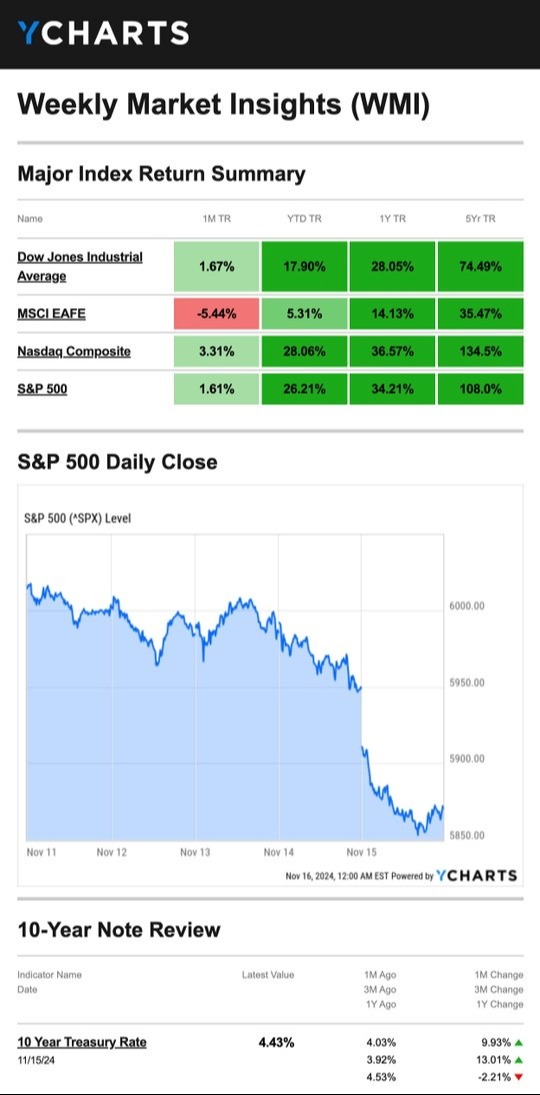
Source: YCharts.com, November 16, 2024. Weekly performance is measured from Monday, November 11, to Friday, November 15. TR = total return for the index, which includes any dividends as well as any other cash distributions during the period. Treasury note yield is expressed in basis points.
Tug-O-War
Last week’s inflation data—both retail and wholesale—showed that the Federal Reserve’s journey to its 2% inflation goal might not be a smooth ride. For the past couple of years, the Fed has focused on curbing inflation by tightening the money supply, aiming to bring prices under control.
Ironically, the strong retail sales figures highlighted consumer confidence and economic resilience, but they also sent mixed signals to investors. On the one hand, confident consumers spending more is good for the economy. On the other hand, this kind of demand could keep inflationary pressures alive, potentially complicating the Fed’s efforts to cool things down. It’s a balancing act—encouraging growth without reigniting inflation.
This Week: Key Economic Data
Monday: Fed Official Austan Goolsbee speaks. Housing Market Index.
Tuesday: Housing Starts and Permits.
Wednesday: Treasury Buyback Announcement.
Thursday: Existing Home Sales. Weekly Jobless Claims. Fed Official Beth Hammack speaks.
Friday: Consumer Sentiment.
Source: Investors Business Daily - Econoday economic calendar; November 15, 2024
The Econoday economic calendar lists upcoming U.S. economic data releases (including key economic indicators), Federal Reserve policy meetings, and speaking engagements of Federal Reserve officials. The content is developed from sources believed to be providing accurate information. The forecasts or forward-looking statements are based on assumptions and may not materialize. The forecasts also are subject to revision.
This Week: Companies Reporting Earnings
Tuesday: Walmart Inc. (WMT), Lowe’s Companies, Inc. (LOW), Medtronic (MDT)
Wednesday: NVIDIA Corporation (NVDA), The TJX Companies, Inc. (TJX), Palo Alto Networks, Inc. (PANW), Target Corporation (TGT)
Thursday: Intuit Inc. (INTU), Deere & Company (DE)
Source: Zacks, November 15, 2024.
Companies mentioned are for informational purposes only. It should not be considered a solicitation for the purchase or sale of the securities. Investing involves risks, and investment decisions should be based on your own goals, time horizon, and tolerance for risk. The return and principal value of investments will fluctuate as market conditions change. When sold, investments may be worth more or less than their original cost. Companies may reschedule when they report earnings without notice.

“If we all worked on the assumption that what is accepted as true were really true, there would be little hope of advance.”
– Orville Wright

I’m not alive, yet I grow. I need air, yet I have no lungs. I lack a mouth, yet water will calm me down. What am I?
Last week’s riddle: What common English-language word becomes shorter when you make it longer?
Answer: Short.


Butchart Garden's Ross Fountain - Summer 2024!
Footnotes and Sources
- The Wall Street Journal, November 15, 2024
- Investing.com, November 15, 2024
- CNBC.com, November 12, 2024
- The Wall Street Journal, November 13, 2024
- The Wall Street Journal, November 14, 2024
- CNBC.com, November 15, 2024
- IRS.gov, May 6, 2024
- Tasty, July 24, 2024
Investing involves risks, and investment decisions should be based on your own goals, time horizon, and tolerance for risk. The return and principal value of investments will fluctuate as market conditions change. When sold, investments may be worth more or less than their original cost.
The forecasts or forward-looking statements are based on assumptions, may not materialize, and are subject to revision without notice.
The market indexes discussed are unmanaged, and generally, considered representative of their respective markets. Index performance is not indicative of the past performance of a particular investment. Indexes do not incur management fees, costs, and expenses. Individuals cannot directly invest in unmanaged indexes. Past performance does not guarantee future results.
The Dow Jones Industrial Average is an unmanaged index that is generally considered representative of large-capitalization companies on the U.S. stock market. Nasdaq Composite is an index of the common stocks and similar securities listed on the NASDAQ stock market and is considered a broad indicator of the performance of technology and growth companies. The MSCI EAFE Index was created by Morgan Stanley Capital International (MSCI) and serves as a benchmark of the performance of major international equity markets, as represented by 21 major MSCI indexes from Europe, Australia, and Southeast Asia. The S&P 500 Composite Index is an unmanaged group of securities that are considered to be representative of the stock market in general.
U.S. Treasury Notes are guaranteed by the federal government as to the timely payment of principal and interest. However, if you sell a Treasury Note prior to maturity, it may be worth more or less than the original price paid. Fixed income investments are subject to various risks including changes in interest rates, credit quality, inflation risk, market valuations, prepayments, corporate events, tax ramifications and other factors.
International investments carry additional risks, which include differences in financial reporting standards, currency exchange rates, political risks unique to a specific country, foreign taxes and regulations, and the potential for illiquid markets. These factors may result in greater share price volatility.
Please consult your financial professional for additional information.