


Stocks had a mixed performance during the first week of December. Technology stocks in the U.S. continued to lead gains, with the Nasdaq Composite Index up 3.34%. The S&P 500 rose 0.96%, while the Dow Jones Industrial Average dipped slightly by 0.60%. Meanwhile, international developed markets, tracked by the MSCI EAFE Index, grew by 1.46%.
In Canada, the S&P/TSX Composite Index had a positive start to December, gaining 216.58 points (about 1.07%) last Friday, closing at 20,452.87, driven by strong performance in base metals, industrials, and telecom stocks. However, the market remains sensitive to fluctuations in the energy sector and currency dynamics, as the Canadian dollar's relative strength and declining oil prices created headwinds earlier in the week.
If you’re keeping an eye on Canadian equities, December has historically been a solid month for the TSX, but this performance could be tempered by ongoing macroeconomic factors, including interest rate decisions from the Bank of Canada.
Tech Takes Charge
It was an exciting week in the markets, especially for tech stocks. The S&P 500 and Nasdaq started the week strong, hitting record highs on both Monday and Tuesday, while the Dow struggled, posting losses those days. Fed Governor Christopher Waller’s comments at a conference—indicating support for a possible rate adjustment in December—seemed to boost confidence in the tech-heavy indices.
Midweek, tech stocks continued to shine, buoyed by several Q3 earnings reports that exceeded expectations. By Friday, the November jobs report gave another push to the S&P and Nasdaq, helping them achieve fresh record highs and secure their third straight winning week. Meanwhile, the Dow didn’t fare as well—it fell in four of the five trading days, snapping its recent streak of weekly gains.
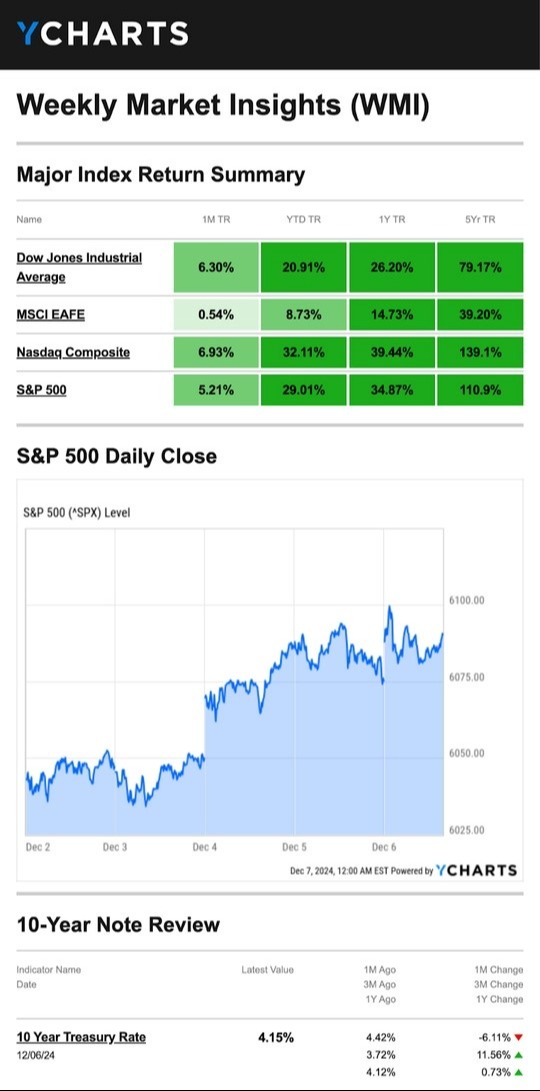
Source: YCharts.com, December 7, 2024. Weekly performance is measured from Monday, December 2, to Friday, December 6. TR = total return for the index, which includes any dividends as well as any other cash distributions during the period. Treasury note yield is expressed in basis points.
Jobs Rebound
November’s jobs report was a relief for many investors. After October’s numbers were weighed down by hurricanes and the aircraft maker strike, November confirmed what most had hoped: October’s data was just a bump in the road. Payroll growth exceeded expectations, a reassuring sign for the labor market.
Interestingly, despite the stronger-than-expected numbers, investors seem confident that it won’t push the Fed to change its current stance on interest rates. The Federal Reserve’s two-day meeting is coming up on December 18, and all eyes will be on any hints about rate adjustments. For now, it looks like this report was a win-win: solid economic momentum without immediate implications for borrowing costs.
This Week: Key Economic Data
Tuesday:Productivity and Costs.
Wednesday:Consumer Price Index (CPI). 10-Year Treasury Note Auction. Treasury Statement.
Thursday:Weekly Jobless Claims. Producer Price Index (PPI). Fed Balance Sheet.
Friday:Import and Export Prices.
Source: Investors Business Daily - Econoday economic calendar; December 6, 2024
The Econoday economic calendar lists upcoming U.S. economic data releases (including key economic indicators), Federal Reserve policy meetings, and speaking engagements of Federal Reserve officials. The content is developed from sources believed to be providing accurate information. The forecasts or forward-looking statements are based on assumptions and may not materialize. The forecasts also are subject to revision.
This Week: Companies Reporting Earnings
Monday:Oracle Corporation (ORCL)
Tuesday: AutoZone, Inc. (AZO)
Wednesday:Adobe, Inc. (ADBE)
Thursday:Broadcom Inc. (AVGO), Costco Wholesale Corporation (COST)
Source: Zacks, December 6, 2024. Companies mentioned are for informational purposes only. It should not be considered a solicitation for the purchase or sale of the securities. Investing involves risks, and investment decisions should be based on your own goals, time horizon, and tolerance for risk. The return and principal value of investments will fluctuate as market conditions change. When sold, investments may be worth more or less than their original cost. Companies may reschedule when they report earnings without notice.

“Life is either a daring adventure, or nothing.”
– Helen Keller

I have a bank, yet no cash. I can run, but can’t walk. I have a bed but never sleep. I have a mouth, but ingest no meals. What am I?
Last week’s riddle: What has one eye and yet can’t see?
Answer: A sewing needle.


A group of Canadian's at "Canada Beach" in Melbourne, Australia.
Footnotes and Sources
- The Wall Street Journal, December 6, 2024
- Investing.com, December 6, 2024
- CNBC.com, December 2, 2024
- MarketWatch.com, December 3, 2024
- CNBC.com, December 4, 2024
- MarketWatch.com, December 5, 2024
- MarketWatch.com, December 6, 2024
- The Wall Street Journal, December 6, 2024
- The Wall Street Journal, December 6, 2024
- IRS.gov, April 4, 2024
- American Heart Association, August 1, 2024
Investing involves risks, and investment decisions should be based on your own goals, time horizon, and tolerance for risk. The return and principal value of investments will fluctuate as market conditions change. When sold, investments may be worth more or less than their original cost.
The forecasts or forward-looking statements are based on assumptions, may not materialize, and are subject to revision without notice.
The market indexes discussed are unmanaged, and generally, considered representative of their respective markets. Index performance is not indicative of the past performance of a particular investment. Indexes do not incur management fees, costs, and expenses. Individuals cannot directly invest in unmanaged indexes. Past performance does not guarantee future results.
The Dow Jones Industrial Average is an unmanaged index that is generally considered representative of large-capitalization companies on the U.S. stock market. Nasdaq Composite is an index of the common stocks and similar securities listed on the NASDAQ stock market and is considered a broad indicator of the performance of technology and growth companies. The MSCI EAFE Index was created by Morgan Stanley Capital International (MSCI) and serves as a benchmark of the performance of major international equity markets, as represented by 21 major MSCI indexes from Europe, Australia, and Southeast Asia. The S&P 500 Composite Index is an unmanaged group of securities that are considered to be representative of the stock market in general.
U.S. Treasury Notes are guaranteed by the federal government as to the timely payment of principal and interest. However, if you sell a Treasury Note prior to maturity, it may be worth more or less than the original price paid. Fixed income investments are subject to various risks including changes in interest rates, credit quality, inflation risk, market valuations, prepayments, corporate events, tax ramifications and other factors.
International investments carry additional risks, which include differences in financial reporting standards, currency exchange rates, political risks unique to a specific country, foreign taxes and regulations, and the potential for illiquid markets. These factors may result in greater share price volatility.
Please consult your financial professional for additional information.