


Last week was a good one for stocks, as they continued to build on the positive vibes from the Federal Reserve’s decision to cut short-term rates by 0.50 percent. The Standard & Poor’s 500 Index climbed 0.59 percent, while the Nasdaq Composite rose 0.95 percent, and the Dow Jones Industrial Average added 0.62 percent. Notably, the MSCI EAFE Index, which tracks developed markets abroad, saw a fantastic gain of 3.53 percent!
The week started off a bit slow, with stocks in the green but not making big moves, even in the face of a disappointing consumer confidence report on Tuesday. Midweek, we saw a bit of a pause as investors took some profits after a solid four-day winning streak.
But then came Thursday, when markets perked up after news that the final Q2 gross domestic product estimate showed the U.S. economy growing at an annual rate of 3.0 percent! On Friday, we got more good news: the Personal Consumption and Expenditures Index revealed that inflation had cooled a bit more than expected in August, which could sway the Fed’s decisions about short-term rates in their upcoming meeting in November.
And to top it all off, Congress passed a continuing resolution last week, which President Biden signed on Friday morning, easing worries about a government shutdown. This resolution will keep the government funded until December 20, so we can breathe a little easier for now!
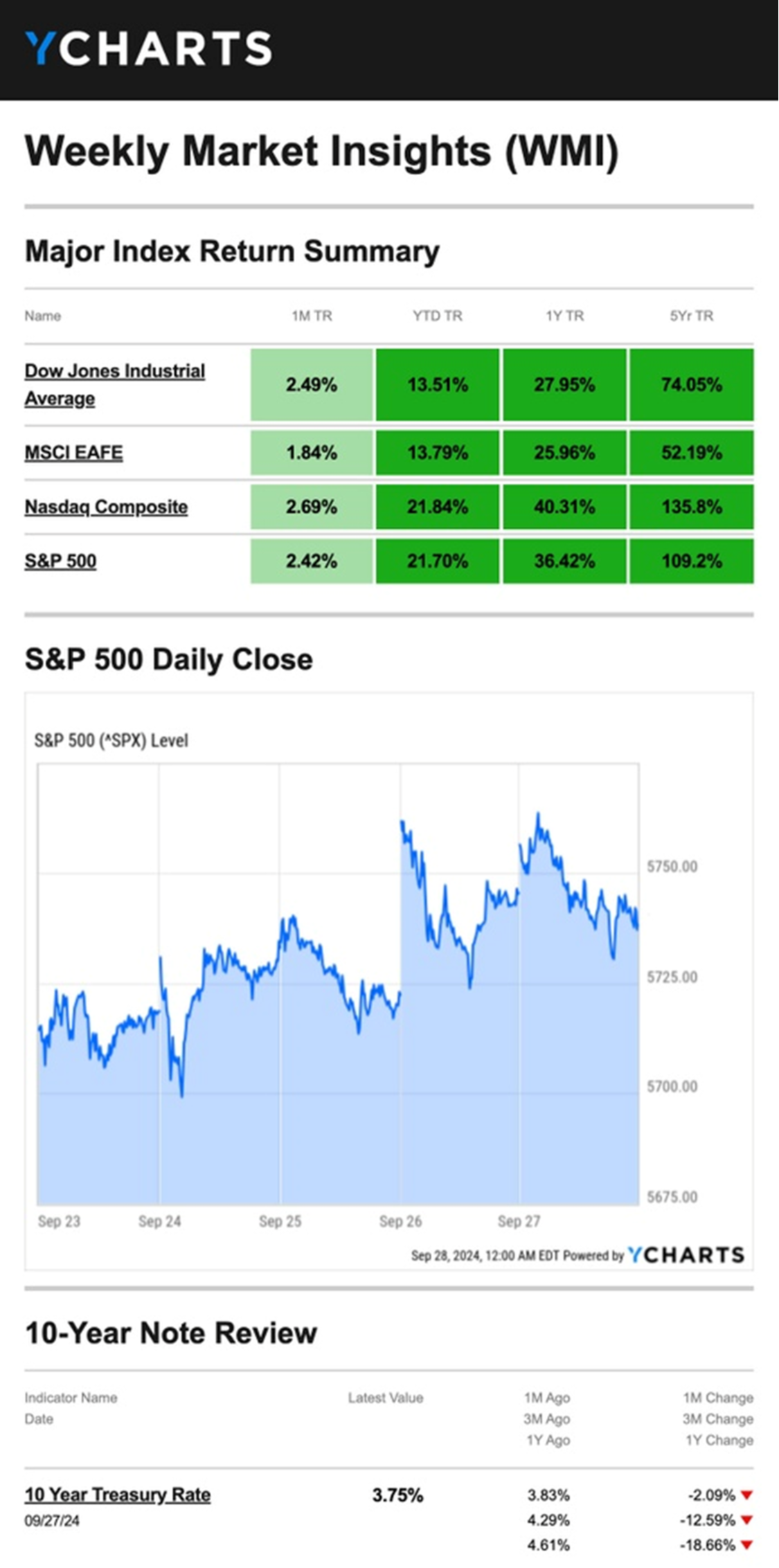
Source: YCharts.com, September 28, 2024. Weekly performance is measured from Monday, September 23, to Friday, September 27. TR = total return for the index, which includes any dividends as well as any other cash distributions during the period. Treasury note yield is expressed in basis points.
China’s Stimulus Package
This week, the spotlight shifted away from the U.S. as international stocks had a fantastic week! The MSCI EAFE Index, which covers Europe, Australia, and the Far East, jumped over 3 percent following the announcement of China’s impressive stimulus package, which could amount to around 2 trillion yuan, or about $284 billion. This package not only cut banks' reserve requirements but also lowered a key short-term interest rate, making waves far beyond China’s borders.
While the EAFE Index doesn’t track Mainland China stocks directly, this stimulus is sure to have a ripple effect on other countries, boosting confidence and market performance.
What’s Coming Up This Week
Here’s a look at some key economic data and events to watch:
- Monday: Fed Chair Jerome Powell and Fed Official Michelle Bowman will be speaking.
- Tuesday: We’ll get insights from the ISM Manufacturing Index and Construction Spending reports, plus comments from Fed Official Raphael Bostic.
- Wednesday: Keep an eye out for the ADP Employment Report and Motor Vehicle Sales, along with speeches from several Fed officials.
- Thursday: We’ll see Jobless Claims, Factory Orders, and the ISM Services Index, along with the announcement of the 10-Year Treasury Note. Raphael Bostic and Neel Kashkari will also be speaking.
- Friday: We’ll wrap up the week with the Employment Situation report and a talk from Fed Official John Williams
Earnings Reports to Watch
This week, several companies will be reporting their earnings:
- Tuesday: NIKE, Inc. (NKE) and Paychex, Inc. (PAYX)
- Thursday: Constellation Brands Inc (STZ)
As always, remember that while the companies mentioned are for informational purposes, investing involves risks. It’s important to base your investment decisions on your own goals and risk tolerance, as values can fluctuate with market conditions.
Let’s keep an eye on these developments together!

"Keep your face always toward the sunshine and the shadows will fall behind you."
- Walt Whitman

I speak without a mouth and hear without ears. I have no body, but I come alive with the wind. What am I?
**Answer to be posted in next week's market recap**


The beauty of the Banff Springs Hotel. A photo from Joanne's summer vacation.
Footnotes and Sources
- The Wall Street Journal, September 27, 2024
- Investing.com, September 27, 2024
- CNBC.com, September 24, 2024
- CNBC.com, September 25, 2024
- BEA.gov, September 26, 2024
- The Wall Street Journal, September 22, 2024 OR
The Hill, September 25, 2024 - The Wall Street Journal, September 27, 2024
- The Wall Street Journal, September 27, 2023
Investing involves risks, and investment decisions should be based on your own goals, time horizon, and tolerance for risk. The return and principal value of investments will fluctuate as market conditions change. When sold, investments may be worth more or less than their original cost.
The forecasts or forward-looking statements are based on assumptions, may not materialize, and are subject to revision without notice.
The market indexes discussed are unmanaged, and generally, considered representative of their respective markets. Index performance is not indicative of the past performance of a particular investment. Indexes do not incur management fees, costs, and expenses. Individuals cannot directly invest in unmanaged indexes. Past performance does not guarantee future results.
The Dow Jones Industrial Average is an unmanaged index that is generally considered representative of large-capitalization companies on the U.S. stock market. Nasdaq Composite is an index of the common stocks and similar securities listed on the NASDAQ stock market and is considered a broad indicator of the performance of technology and growth companies. The MSCI EAFE Index was created by Morgan Stanley Capital International (MSCI) and serves as a benchmark of the performance of major international equity markets, as represented by 21 major MSCI indexes from Europe, Australia, and Southeast Asia. The S&P 500 Composite Index is an unmanaged group of securities that are considered to be representative of the stock market in general.
U.S. Treasury Notes are guaranteed by the federal government as to the timely payment of principal and interest. However, if you sell a Treasury Note prior to maturity, it may be worth more or less than the original price paid. Fixed income investments are subject to various risks including changes in interest rates, credit quality, inflation risk, market valuations, prepayments, corporate events, tax ramifications and other factors.
International investments carry additional risks, which include differences in financial reporting standards, currency exchange rates, political risks unique to a specific country, foreign taxes and regulations, and the potential for illiquid markets. These factors may result in greater share price volatility.
Please consult your financial professional for additional information.